GEA sees new potential in dairy breeding as CattleEye data supports genetic approaches to lameness
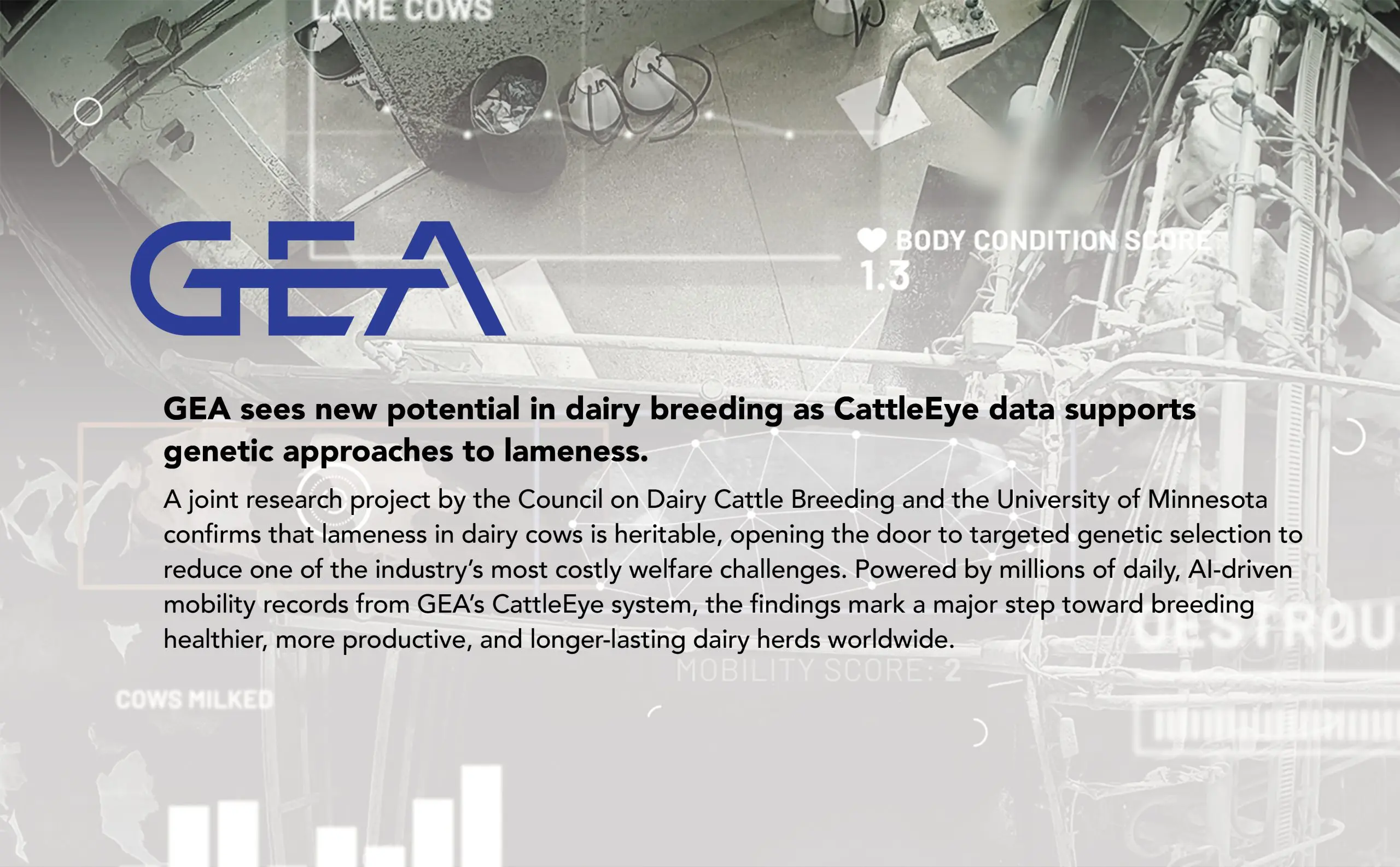
GEA sees new potential in dairy breeding as CattleEye data supports genetic approaches to lameness
New research from the CDCB and the University of Minnesota shows lameness is heritable, opening the door to breeding strategies that could reduce its impact.
ROMEOVILLE, Ill. [Feb. 3, 2026] – A joint research project by the Council on Dairy Cattle Breeding (CDCB) and the University of Minnesota (UMN) presented new findings on the genetic basis of lameness in dairy cows at the 2025 World Dairy Expo. The results confirm that lameness is not just a management challenge – it is also heritable to a meaningful degree, indicating that targeted breeding strategies could reduce it over time.
These new insights have been enabled through the large, consistent datasets collected via the AI-based CattleEye video system, distributed globally by GEA. For the first time, researchers have access to millions of objective, daily mobility assessments – a level of scale and precision that traditional manual scoring systems could never economically provide.
“We’re looking at breeding cows that simply don’t get lame as often,” says Terry Canning, senior director at GEA and founder of CattleEye. “This isn’t about treating lameness better or catching it earlier – it’s about creating herds where the problem largely doesn’t occur. That’s transformational for animal welfare and farm economics.
New genetic traits in development
The findings presented at World Dairy Expo highlight two potential new genetic traits under development:
- Mobility: A novel trait derived from AI-generated mobility scores collected via CattleEye’s video analytics platform.
- Hoof Health: Based on lesion data collected by professional hoof trimmers.
While the heritability of hoof disorders has been known for years, this study is the first to combine daily, objective mobility data at this scale with genomic information. That combination makes it possible to quantify the heritability of mobility itself – a direct measure of how smoothly an animal walks. Preliminary analysis by the CDCB suggests heritability of 10% to 30%, providing a strong foundation for breeding more resilient herds over time.
“The combination of big data, artificial intelligence, and genetics is transforming how we understand animal health,” says Maximilian Jacobi, senior director of market and product management at GEA. “Our customers see CattleEye not only as a diagnostic tool, but as a data platform that empowers them to actively breed for healthier, more durable herds.”
A milestone for animal welfare, productivity and sustainability
Lameness remains one of the most significant economic and welfare challenges in dairy production worldwide. Depending on region, herd size, lameness severity and management conditions, the annual costs for dairy farms can be substantial.
Beyond direct treatment costs, lameness affects milk yield, fertility and animal longevity. Modeling studies and review articles suggest that the costs per affected cow average around $350-400 per year, with variations depending on country, housing system and disease prevalence.
From early detection to long-term genetic gains
GEA CattleEye provides daily, objective mobility data that enables early detection and serves as the foundation for future genetic selection.
“This collaborative research is a prime example of pairing existing information – hoof trimmer records, with novel insights and camera data – to address high-impact issues on dairy farms,” says Javier Buchard, chief innovation officer at CDCB. “Genetic solutions are a powerful tool to drive cumulative and permanent improvements in herd health beyond environmental factors.”
Within three to five years, farmers could select breeding stock with substantially lower lameness risk. Their daughters can potentially stay healthier, produce more milk, conceive faster and remain in the herd longer.
By integrating CattleEye data into national breeding programs, the project is creating the first closed-loop, data-linking system between barns, science and breeding organizations.
For dairy producers, this means:
- Early detection of lameness through automated AI monitoring.
- Genetic selection for cows with greater mobility resilience.
- Healthier, longer-living cows that produce more milk and require fewer interventions.
“For our customers, this means lameness can not only be better managed – but that we can also make a genetic contribution to reducing it over time,” says Jacobi. “The project shows the added potential that emerges when AI, big data and genetics come together.”
Background
The CDCB-UMN project began in July 2021 and is partly funded by the Foundation for Food and Agriculture Research (FFAR). CattleEye technology is now being deployed across more than 200,000 cows. The data will contribute to the development of national genetic indices for hoof health and mobility, giving dairy producers worldwide a tool to breed more efficient, resilient and welfare-friendly herds.
About GEA
GEA is one of the world’s largest suppliers of systems and components to the food, beverage and pharmaceutical industries. The international technology group, founded in 1881, focuses on machinery and plants, as well as advanced process technology, components and comprehensive services.
With more than 18,000 employees, the group generated revenues of about EUR 5.4 billion in more than 150 countries in the 2024 fiscal year. GEA plants, processes, components and services enhance the efficiency and sustainability of customers’ production. They contribute significantly to the reduction of CO2 emissions, plastic usage and food waste. In doing so, GEA makes a key contribution toward a sustainable future, in line with the company’s purpose: “Engineering for a better world.” GEA is on the German MDAX, the STOXX® Europe 600 Index and is also a constituent of leading sustainability indices DAX 50 ESG, MSCI Global Sustainability and Dow Jones Best-In-Class World.