How GEA Dairy Herd Management Systems Improve Efficiency
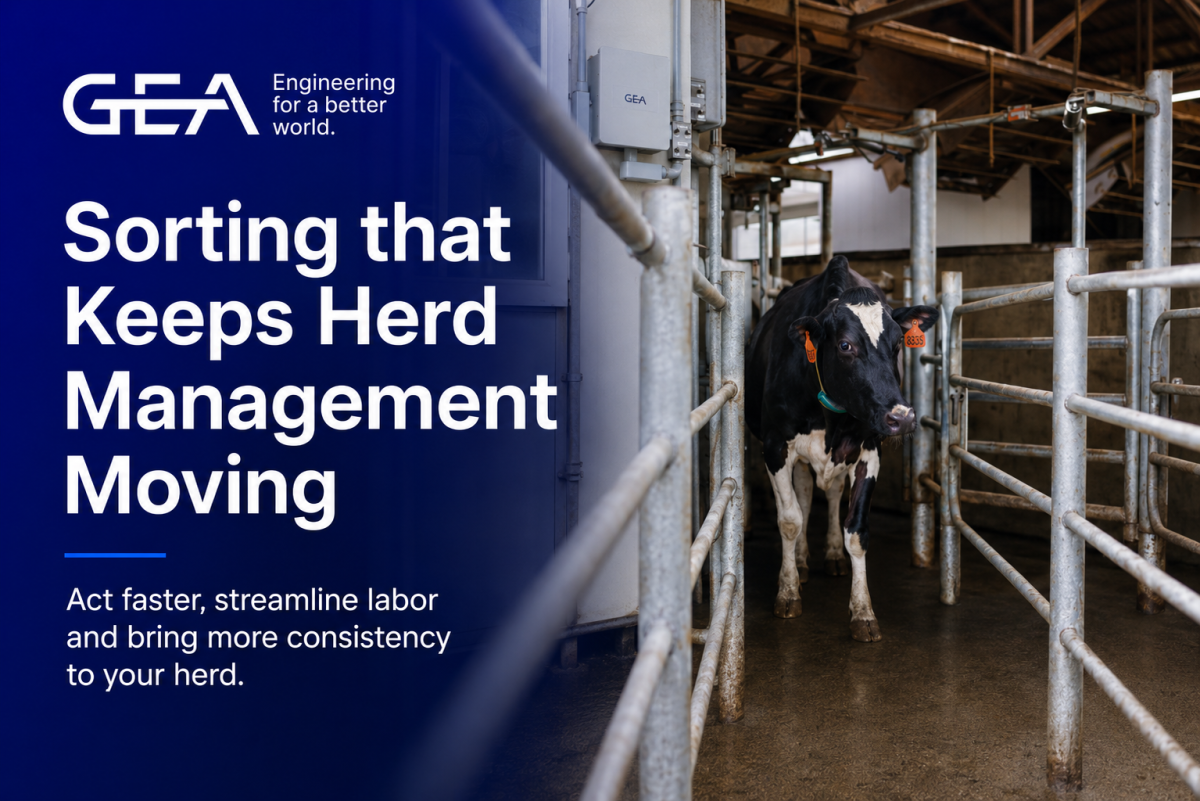
Sorting that Keeps Herd Management Moving
Act faster, streamline labor and bring more consistency to your herd.
ROMEOVILLE, Ill. [May 7, 2026] – Top-performing dairies don’t just identify the cows that need attention; they act on that information immediately. When herd monitoring and sort gates work together, it becomes easier to follow through consistently and ensure nothing gets missed.
“If a cow gets identified but nothing happens next, you lose the value of that information. Sorting closes that loop,” says Stephanie Finn, business development manager for herd management solutions at GEA.
Here’s how top-performing dairies use sorting and monitoring together to drive more consistent results:
1. Turn identification into action
The strongest routines don’t rely on someone remembering to act — they build routines that ensure the right cows are sorted and managed every time.
“Monitoring is going to identify the cow, and the sorting mechanism ensures that she’s acted on,” says Jamie Fox, product manager at GEA. “It turns a search process into a controlled workflow.”
For example, instead of locking up an entire pen to check fresh cow temperatures each morning, one Washington dairy uses health scores from their monitoring system to automatically sort only the cows that need attention after milking. Because monitoring and sorting work together, cows are identified and addressed in the same pass. The result is less unnecessary handling, faster response times and more consistent protocols.
Instead of reacting after issues escalate, farms can respond earlier, improving health and reproduction outcomes.
“You’re putting the right cows in front of employees to apply treatment, then sending them right back,” Finn explains. “If a cow doesn’t need to be handled, let her be a cow.”
2. Build trust through results
Adopting new technology often comes with skepticism, especially from experienced team members who already perform at a high level.
Finn recalls working with a highly skilled breeder who initially doubted the system. After comparing monitoring system data to pregnancy checks, he found that most open cows had shown heat, even when he didn’t catch it visually.
That insight changed how he worked. Instead of relying solely on observation, he began using alerts to act faster and time insemination more precisely, even if it meant breeding at off-hours. He improved performance in an area where he already excelled.
“That’s where these systems shine,” says Finn. “They don’t replace good people — they help them perform even better.”
That kind of proof is often what turns skepticism into consistent action.
3. Create discipline and accountability
Technology only works if people use it — and use it the same way every day.
“High-performing dairies don’t always have more technology,” says Fox. “Their execution is better, and that’s where operational discipline comes in.”
Successful farms operationalize their systems in three ways:
- Establishing clear protocols for acting on alerts
- Building daily routines around key data points
- Ensuring team alignment and accountability
“Most challenges come down to management and consistency,” says Finn. “If employees aren’t willing to utilize the information, you’re not going to get your money back out of it.”
For example, some dairies designate one employee per shift to work the sort pen, ensuring no cows are missed and no decisions are delayed.
Clear protocols and consistent follow-through are what keep good information from going unused.
4. Maintain the system to protect accuracy
Minor issues can quickly erode performance if left unchecked.
“Small inconsistencies in maintenance, repeated day after day, can lead to bigger financial losses over time,” says Fox.
Monitoring systems rely on accurate, consistent data. Proper tag placement, functioning antennas, battery life, system connectivity and timely maintenance all play a role. If a reader goes down or tags aren’t transmitting correctly, farms can start missing heats or health changes within days, quickly undermining trust in the system.
“The human element in maintenance is often overlooked,” Finn notes. “But it’s critical to keep the system working as intended.”
Simple routines — like regularly checking tag function, walking antennas and reviewing system alerts — can prevent larger issues down the line.
5. Maximize value with ongoing support
Getting started is only the beginning. Ongoing support often makes the difference between seeing a return and leaving value on the table.
Working with connected systems, especially from a single provider, can help reduce delays between insight and action, making it easier to keep protocols moving.
“These aren’t set-it-and-forget-it tools,” says Finn. “You need ongoing training and someone to guide you as you’re ready to take the next step.”
Farms that get the most value from these systems tend to:
- Continuously refine protocols
- Expand how they use alerts and data
- Revisit goals as performance improves
- Lean on trusted advisors for support
“They’re always asking, ‘What more can we get out of this system?’” she adds.
For example, a farm that starts with fresh cow monitoring may later expand into reproduction protocols, then labor optimization — building value step by step.
Farms that see the greatest return continue learning, refining and expanding how they use them.
Monitoring systems identify the right cows. Sort gates ensure something actually happens next. When paired with consistent execution, farms can respond faster, reduce labor inefficiencies and improve herd performance.
When monitoring and sorting work together, farms can act faster and improve follow-through. Contact your local GEA dealer to learn more.
About GEA
GEA is one of the world’s largest suppliers of systems and components to the food, beverage and pharmaceutical industries.
The international technology group, founded in 1881, focuses on machinery and plants, as well as advanced process technology, components and comprehensive services. For instance, every second pharma separator for essential healthcare products such as vaccines or novel biopharmaceuticals is produced by GEA. In food, every fourth package of pasta or every third chicken nugget are processed with GEA technology.
With more than 18,000 employees, the group generated sales of about EUR 5.5 billion in more than 150 countries in the 2025 fiscal year. GEA plants, processes, components and services enhance the efficiency and sustainability of customers’ production. They contribute significantly to the reduction of CO2 emissions, plastic usage and food waste. In doing so, GEA makes a key contribution toward a sustainable future, in line with the company’s purpose: “Engineering for a better world.”
GEA is listed on the German DAX, the European STOXX® Europe 600 Index and is also a constituent of the leading sustainability indices DAX 50 ESG, MSCI Global Sustainability and Dow Jones Best-in-Class World.
Follow us on Facebook! American Dairymen | Facebook