
Lameness in Dairy Cattle
Lameness in Dairy Cattle
Lameness is one of the biggest welfare and economic challenges facing dairy herds. Between 80% and 90% of cases originate in the hoof. These cases are generally classified as either infectious, such as foot rot and digital dermatitis, or non-infectious, including sole ulcers and white line disease. Pain from lameness reduces milk production and often leads to early culling.
Andrew Niehaus, DVM, MS, Clinical Professor in the Department of Veterinary Clinical Sciences at The Ohio State University College of Veterinary Medicine, says many conditions can cause lameness, though some are easier to diagnose than others.
“We often teach students the 90% rule,” says Niehaus. “About 90% of bovine lameness originates below the fetlock, 90% occurs in the rear legs, and 90% affects the lateral, or outside, claw of the rear feet because those claws bear the most weight. It isn’t a hard-and-fast rule, but it has been used for more than 50 years as a reminder of where most lameness problems occur.”
In the hind feet, the outside claw carries more weight. In the front feet, more weight is placed on the inside claw, making those weight-bearing claws larger.
Scott E. Poock, DVM, DABVP (Dairy), Extension Professor at the University of Missouri, says white line disease, abscesses, sole ulcers and hairy heel warts are among the most common foot problems in dairy cows.
“Forty years ago, veterinarians were usually the only people treating feet,” says Poock. “Then professional hoof trimmers came along, and that made a tremendous difference. Routine maintenance trimming keeps feet balanced and helps prevent many problems before they develop.”
Maintenance trimming has also evolved over time.
“We originally trimmed cows once each lactation at dry-off,” Poock explains. “Today, many progressive dairies trim feet twice during each lactation. Preventive trimming is always better than waiting until cows become lame.”
Routine hoof care reduces stress, pain and lost milk production while preventing many common lameness issues.
Lameness Scoring
Sebastián G. Umaña Sedó, DVM, MSc, DVSc, Assistant Professor of Production Management Medicine at Virginia Tech, says lameness affects both productivity and animal welfare.
“Dairy cows need to walk to the milking parlor two or three times each day,” he says. “Pain decreases their appetite and feed intake, which lowers milk production. Animal welfare is also a major concern.”
Early detection begins with careful observation.
“Workers need to monitor cows and recognize early signs of lameness,” Sedó says. “We use a scoring system that evaluates how cows walk on a flat surface.”
The lameness scoring system ranges from 1 to 5:
Score 1–Normal: The cow stands and walks with a level back and normal gait.
Score 2–Mildly Lame: The cow stands with a level back but arches her back while walking. Her gait remains normal.
Score 3–Moderately Lame: An arched back is visible while standing and walking. The cow takes shorter strides and one or more limbs are affected.
Score 4–Lame: The cow consistently has an arched back and walks one deliberate step at a time while favoring one or more feet.
Score 5–Severely Lame: The cow is unable or extremely reluctant to bear weight on one or more limbs.
With proper training, workers can detect cows that score a 2.
“There may only be slight arching of the back and a slightly shorter stride,” Sedó explains. “Those changes are subtle.”
A score of 3 is much easier to identify because the affected limb becomes obvious. The cow can still bear weight but quickly shifts weight off that leg.
“It is important to train dairy workers to identify score 2 cows before they progress to score 3,” Sedó says. “Many large dairies have employees dedicated to observing cows in the pens and as they leave the milking parlor. If slight lameness is detected, those cows are moved to the trimming chute for diagnosis and treatment.”
Farms without enough trained employees often miss these early cases. By the time lameness is noticed, the condition may already be much more severe. Catching problems at a score of 2 provides the best opportunity for successful treatment.
Looking Beyond the Hoof
Although most lameness begins in the foot, a complete physical examination remains essential.
“Lameness can originate in the hock, stifle, hip, back or other areas,” says Niehaus. “Recent feedlot research suggests stifle and hip lameness may be more common than we once believed. Even so, the foot remains the most common source.”
Modern technology is making early detection easier.
Activity collars now monitor eating, rumination and movement. Algorithms analyze the data and alert producers when a cow’s behavior changes, allowing them to investigate before clinical signs become severe.
Some systems also use cameras placed in alleys or milking parlors. These cameras monitor posture and back angle while cows walk, giving producers additional “eyes” on the herd and helping identify lame cows sooner.
Prevention Starts with Cow Comfort
“Lameness is all about prevention,” says Sedó. “If we have to treat lameness, we are already too late.”
Because dairy cows carry significant weight on their feet and legs, comfortable housing is essential.
Proper bedding and secure footing encourage cows to lie down. When stalls are uncomfortable, cows spend too much time standing.
“Many cows begin what we call perching,” Sedó explains. “They stand partly in the alley and partly in the stall, trying to relieve pressure on their feet because the bedding isn’t comfortable enough. The longer they remain standing, the greater the risk of lameness.”
Foot Problems
Many conditions can lead to lameness, says Niehaus. Lesions range from laminitis to foot rot.
“Laminitis is something we usually associate with horses, but it can also affect cattle,” he says.
Laminitis can make cattle more susceptible to other hoof diseases. Separation between the hoof wall and bone, or between the wall and sole, can lead to white line disease and softening of the hoof. Hoof growth becomes poor, grooves may develop, and cracks can form. Animals that founder are also more likely to develop abscesses and sole ulcers.
Nutrition’s Role
Diet is one factor that can contribute to laminitis.
“A very high-concentrate diet with a lot of carbohydrates can create problems,” says Niehaus. “We see this in both dairy cows and feedlot cattle.”
Environmental Factors
The environment also has a major impact on hoof health.
Are cattle on pasture, or housed on concrete? Are their feet constantly wet from manure slurry because the barn is dirty? Do they stand in mud and manure in wet lots?
“Constant moisture is harmful to hoof horn,” says Niehaus. “It also increases the risk of infections such as foot rot, which can spread deeper into the digit.”
Infectious Causes of Lameness
Lameness can result from trauma, mechanical injuries or infectious diseases.
One of the best preventive tools is the footbath. Cows walk through it when leaving the alley or milking parlor, ensuring each foot contacts the solution multiple times.
Copper sulfate and formaldehyde are commonly used because of their antibacterial properties.
Footbaths primarily help prevent bacterial infections such as digital dermatitis and interdigital dermatitis.
Both diseases are associated with wet, muddy conditions but differ in location and appearance.
Digital dermatitis typically affects the skin around the heel bulbs at the back of the foot. Interdigital dermatitis develops deeper in the skin between the two claws.
Digital Dermatitis vs. Interdigital Dermatitis
“On dairy farms, digital dermatitis is more common, while beef cattle more often develop interdigital dermatitis,” says Sedó.
Both diseases are caused by bacteria that invade deep into the tissues.
Footbath frequency depends on how common the disease is within the herd.
“If a farm has a high incidence of interdigital dermatitis, cows may need to go through footbaths six times per week or more,” Sedó says. “If prevalence is below 5% to 10%, four treatments each week may be enough. Prevention is always better than treatment.”
Using copper sulfate footbaths also helps reduce antibiotic use.
“Copper sulfate can be somewhat abrasive,” Sedó says, “but reducing antibiotic use is beneficial in the long run.”
Abscesses and Deep Infections
Some infections lead to painful hoof abscesses filled with pus.
Superficial abscesses may rupture or be opened to drain. Deep abscesses, however, can spread into the digit or even the coffin joint.
“The bone and tendons can also become infected,” says Niehaus.
The deep digital flexor tendon attaches to the coffin bone (P3), while the navicular bone sits behind it within the coffin joint. Each claw has its own navicular bone and bursa, which cushions the tendon as it moves.
If infection reaches these structures, serious complications can occur.
“The tendon attachment can become infected and begin pulling away from the bone,” Niehaus explains. “The toes may tip upward, creating severe lameness.”
Infection may also spread into the tendon sheath.
“The tendon is enclosed within a protective sheath,” he says. “Once infection enters that sheath, it can travel up the leg. What started as a simple ulcer or abscess can become a much more serious problem.”
Hairy Heel Warts
Cows may also develop hairy heel warts.
“They’re similar to foot rot but affect the back of the heel and are extremely painful,” says Niehaus.
Accurate diagnosis is essential, both for the individual animal and the herd.
“Environmental conditions and nutrition can both predispose cattle to these problems.”
Poock says certain antibiotics are effective against hairy heel warts.
“There was once a vaccine for hairy heel warts,” he says. “In my experience, however, it wasn’t very effective.”
Poock tested the vaccine in a herd with ongoing problems by vaccinating half the cows.
“At the end of the year, both vaccinated and unvaccinated groups had the same number of hairy heel wart cases.”
Trauma-Induced Lameness
Two of the most common trauma-related hoof problems are sole ulcers and white line disease.
Both are largely influenced by the environment.
Hooves naturally wear over time while new hoof horn grows to replace it. When wear does not keep pace with growth, hooves become overgrown and toes become too long.
Sole Ulcers
“When toes become too long, the bone inside the hoof shifts out of balance,” says Sedó.
“The bone is pushed downward toward the heel and eventually creates a sole ulcer. This is an extremely painful condition.”
Corrective hoof trimming restores normal hoof balance and helps relieve pressure by returning the claw to a more natural angle.
White Line Disease
White line disease is commonly associated with hard surfaces such as concrete and rocks.
Poor pen cleanliness also contributes.
“Manure softens the hoof horn,” says Sedó. “Its acidity gradually erodes the hoof.”
The white line, located between the sole and hoof wall, is the softest part of the hoof.
“It acts like the glue that holds everything together,” he explains.
Constant exposure to manure weakens this area.
Rocks, gravel and debris can then become lodged in the white line, leading to painful sole abscesses.
“This is why prevention and maintaining a clean environment are so important.”
Other Hoof Problems
Cattle can also develop corns, also known as interdigital fibromas.
These are firm, fibrous masses that develop between the claws.
They are often caused by chronic skin irritation or poor hoof conformation that allows the toes to spread apart.
Lameness Above the Foot
Although most lameness begins in the hoof, injuries higher up the leg can also cause significant problems.
“Cattle can develop stifle injuries, including cruciate ligament damage similar to what we see in dogs,” says Niehaus. “The injuries are often more severe because cattle are much larger, and they’re harder to diagnose because you can’t manipulate the leg as easily.”
Cruciate ligament rupture is a common cause of hind-limb lameness involving the stifle joint, which is similar to the human knee. It usually results from trauma, such as slipping or falling on ice or concrete, or from exertion during breeding. Degenerative changes and obesity can also increase the risk.
Hip Injuries
“We also occasionally see other ligament injuries and hip problems,” Niehaus says.
Fresh cows are especially vulnerable.
“The most common hip problem occurs after freshening when cows are weak and their hind legs may splay apart.”
Hip injuries also occur during estrus when cows are mounted by other cows or a bull.
“If a cow falls with another large animal on top of her, her hind legs may splay behind her. That can also result in stifle injuries.”
Fractures occur as well, although they are more common in calves than adult cattle.
“A calf may be stepped on or pulled too hard during delivery,” Niehaus says. “All of these injuries can result in lameness.”
Diagnosis
Determining the cause of lameness can sometimes be difficult, making a thorough physical examination essential.
“We always begin with the history,” says Niehaus. “We want to know how long the problem has been present, what the environment is like and what the cow is eating.”
The examination begins by observing the animal from a distance.
Veterinarians evaluate how the cow walks, how much weight she places on each leg and the length of her stride.
“A lame cow shortens her stride,” Niehaus explains. “She puts less weight on the painful leg and more weight on the sound leg, often landing harder on that limb.”
Age also plays a role.
“Maybe the cow is simply getting older and arthritic,” he says. “Or maybe there’s a problem we can correct. If a high percentage of the herd is lame, then we also need to evaluate management at the herd level.”
Starting with the Foot
A complete history, physical examination and observation are all important.
“When we examine the cow, we usually begin with the foot unless another obvious problem is present,” says Niehaus.
Evaluating the upper limb often requires laying the cow down, making the procedure more difficult and stressful.
“If we find an abscess or another hoof problem, we don’t continue searching elsewhere.”
Most cows are restrained on a hoof-trimming table, which protects both the animal and the people performing the examination.
The hoof is cleaned thoroughly before evaluation.
“We often use hoof testers to squeeze different areas of the hoof and identify painful spots,” Niehaus says. “If we locate a sensitive area, we’ll carefully debride it to look for an abscess or foreign object beneath the sole.”
Some lesions require little investigation.
“Hairy heel warts are usually obvious,” he says. “Simply touching them causes pain.”
Corns, or interdigital fibromas, are also easy to identify.
“Sometimes they’re incidental findings, but other times they become large enough to spread the claws apart. They may crack, become infected and become painful.”
Veterinarians also check for swelling above the hoof.
“I palpate around the digits because swelling can indicate cellulitis or an infection that’s spreading up the leg,” says Niehaus.
The white line also receives close attention.
“We usually trim the hoof during the examination because overgrown claws make evaluation more difficult. Trimming exposes healthy tissue and helps distinguish healthy tissue from diseased tissue.”
If the white line has separated, debris is removed to determine whether deeper tracts or more serious disease are present.
Niehaus also uses a towel or cloth to floss the interdigital space.
“Normally this shouldn’t be painful,” he says. “Pain often indicates infection such as foot rot.”
Advanced Diagnostics
Some cases require more advanced imaging.
“Radiographs are usually my next step if I suspect bone or joint involvement,” says Niehaus.
Although taking X-rays on the farm can be challenging, they provide valuable diagnostic and prognostic information.
“If the joint is involved, the condition is much more serious. Treatment becomes more aggressive, more expensive and the prognosis is poorer.”
Whether advanced treatment is pursued often depends on the cow’s genetic value.
Ultrasound is also useful.
“It allows us to evaluate soft tissue structures such as tendons and tendon sheaths,” Niehaus says.
Radiographs and ultrasound are the most common advanced diagnostic tools used in cattle because they remain affordable for most producers.
Diagnosing hip and stifle problems is more difficult.
“A physical examination can reveal swelling or asymmetry,” Niehaus says. “Some bony structures can be seen and palpated externally.”
Radiographs of the hip and stifle are challenging even at a university hospital.
“Most valuable animals requiring advanced imaging are referred.”
Treatment Options
Treatment depends on the underlying cause.
“After determining what’s wrong, we may debride lesions, open and drain abscesses or clean ulcerated tissue,” says Niehaus.
One major advantage in cattle is that they have two claws.
“Most lesions involve only one claw. We can glue a hoof block to the healthy claw to remove weight and pressure from the painful one.”
Toe Blocks
Toe blocks are inexpensive and greatly improve comfort while promoting faster healing.
They are most effective when only one claw is affected.
If both claws are involved, or if the problem is higher in the leg, toe blocks provide little benefit.
Fortunately, most lesions affect only one claw, usually in the hind foot.
Joint Fusion
If infection extends into the joint, more advanced surgery may be required.
“We may debride the joint and perform a facilitated ankylosis,” Niehaus says.
Unlike horses, cattle generally are not treated with plates and screws because implants become infected and the procedure is expensive.
Instead, veterinarians clean the joint, remove infected tissue and cartilage, then allow the bones to fuse naturally.
The leg is immobilized in a cast for four to six weeks.
Although the joint becomes stiffer, the cow is usually much more comfortable and can walk without pain.
Toe Amputation
Toe amputation is another option for severe infections.
“The cow generally manages well with one toe,” Niehaus says.
The drawback is that the remaining toe must bear more weight, increasing the likelihood of future problems.
“Long-term results are generally better when we can preserve the digit through facilitated ankylosis.”
Importance of a Good Environment
Comfortable cows are healthier and more productive.
Housing plays a major role in hoof health.
During hot weather, cows often spend less time lying down.
Poor bedding also keeps cows on their feet longer, increasing stress on their legs and hooves.
Cows naturally spend many hours lying down while chewing their cud.
“They need a comfortable place to rest,” says Niehaus.
Clean, dry conditions are ideal.
“Some farms can’t always keep footing dry, especially during certain seasons,” he says. “But it’s important to provide areas where cows can get out of mud and manure and allow their feet to dry.”
Moving repeatedly between muddy lots and manure slurry is especially hard on hooves.
Heat Stress
Poock says hoof problems increase during summer.
“We see more hoof ulcers and abscesses because heat stress can contribute to laminitis.”
Hot cows spend more time standing because lying down makes them feel warmer.
Standing longer increases pressure on their feet.
Good ventilation is critical.
“Place fans over holding areas, feed bunks and stalls,” Poock says. “Sprinkler systems also help cool cows. Cooler cows spend more time lying down.”
Employees also influence hoof health.
Cows should never be rushed to the milking parlor.
Allow them to walk at their own pace, and avoid making them stand in holding pens for long periods.
Standing for an hour or more places unnecessary pressure on their feet.
Stocking density matters as well.
“If too many cows occupy a small area, you’ll usually see more lameness.”
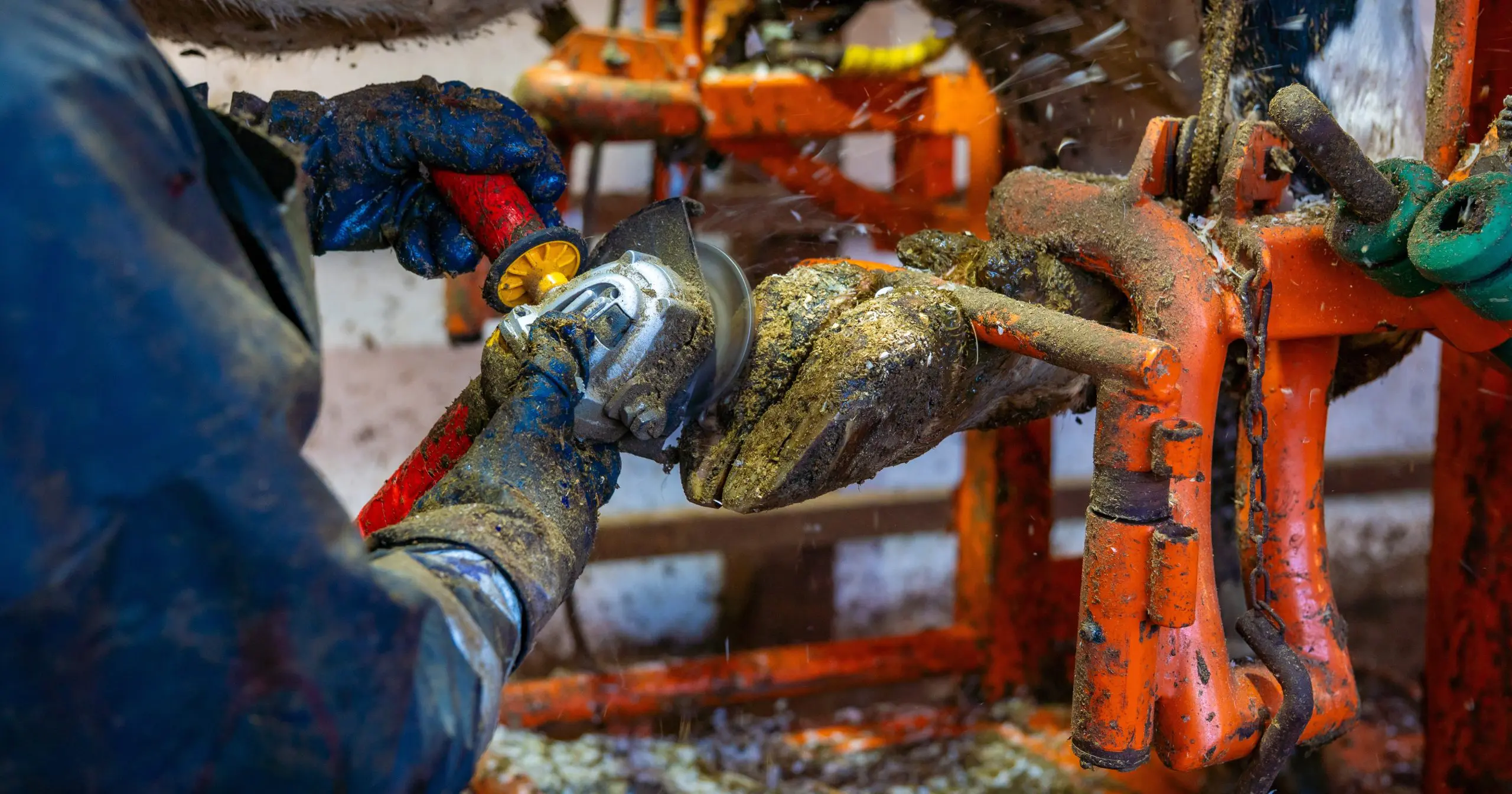
Hoof Trimming
Routine hoof trimming restores proper balance and prevents many problems.
One of the biggest issues is long toes because dairy cows usually cannot wear their hooves as quickly as they grow.
“Long toes shift the foot backward,” says Niehaus. “That increases pressure on the heels, predisposes cows to heel ulcers and places additional stress on tendons.”
Poock says professional hoof trimmers successfully treat conditions such as foot rot and sole abscesses.
“Years ago, before hoof blocks were available, treatment was much more difficult,” he says. “Now we can apply a hoof block to the healthy claw and remove weight from the injured one while it heals.”
Education Matters
Proper trimming technique is essential.
Educational workshops help train producers and hoof trimmers.
“Karl Burgi in Wisconsin and Dr. Jan Shearer at Iowa State University conduct excellent training schools,” says Poock. “Preventing problems is always better than treating them.”
Sedó agrees.
“Proper hoof trimming is extremely important,” he says. “If it’s done incorrectly, serious damage can occur.”
He encourages producers who want to trim their own cattle to attend professional training workshops.
“There are excellent instructors who teach farmers and employees the proper techniques. Learning to trim correctly helps prevent many hoof problems before they occur.”
Follow us on Facebook! American Dairymen | Facebook