
Hairy Heel Warts (Bovine Digital Dermatitis)
Hairy Heel Warts (Bovine Digital Dermatitis)
By Heather Smith Thomas
This painful foot disease (technically known as digital dermatitis) has often been called hairy heel warts or strawberry foot rot, and has been a common problem in dairies for a long time. Terry Engelken, DVM MS (College of Veterinary Medicine, Iowa State University) says it is much more difficult to diagnose, prevent and treat than foot rot.
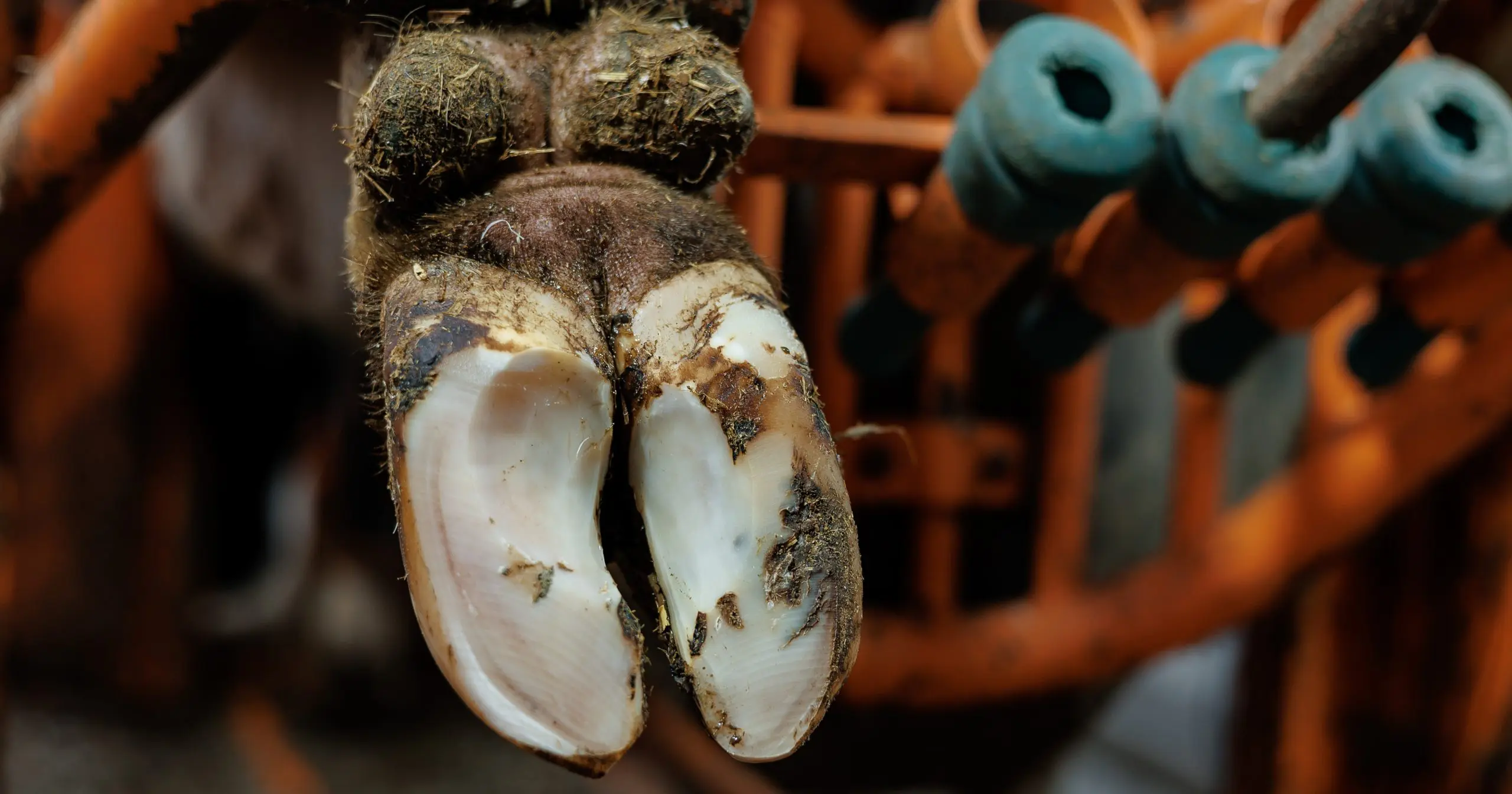
“We generally see digital dermatitis (DD) lesions at the back of the foot, between the two claws, in the coronary band/hairline. It usually starts as a small erosion and works upward. The chronic, classical sign—where it gets the name hairy heel wart—is deep erosions and proliferative tissue growing out from those areas. This tissue looks like hair growing out of the lesion,” he says.
At some point between the start of the infection and when those proliferations become visible is when the animal shows lameness. Not all infected cattle are lame at first, so it’s hard to diagnose early. The disease may quietly percolate in a group of cows before you notice it.
“By the time you see lame cows, there may be many cattle in that group with early lesions that will become lame later. There is no consistent reason for why it behaves the way it does. We tend to see it in a lot of cattle at a particular dairy—in outdoor pens, bedded packs, indoor facilities, etc.,” says Engelken.
CAUSE – Research has indicated that—just like foot rot–there has to be some kind of initial trauma to the skin for the infection to start. “It is interesting that probably 80 to 90% of cases are on the back feet,” says Engelken. Pen and footing conditions might be a factor, at least in the initial outbreak. If pens are too wet or if they are frozen, or cows are on concrete flooring—any footing with rough spots—the skin may become damaged. Many of the organisms typically found in these lesions are unable to penetrate intact, healthy skin.
Digital dermatitis is caused by multiple bacteria working together. It’s never just one organism alone. “Biopsies of lesions, to determine which families of bacteria are present, have found anywhere from 12 to 20 different bacteria. The ones that show up in an early lesion are very different from the ones we generally find later in the chronic lesions,” Engelken says.
Matt Miesner, Professor, Agricultural Practices, Kansas State University says this disease can be diagnosed with a biopsy of the lesion. Treponema, a spirochete bacteria often found in these lesions, can be seen under a microscope and looks like a corkscrew or spring, in a spiral shape.
“The disease itself is multifactorial, however. It may take several factors working together for cattle to become susceptible. Something that breaks down the skin barrier to allow bacteria is probably necessary. Secondly, there are a host of other bacteria that help it along, making the tissues more susceptible, to enable the spirochete to dig in. These environmental bacteria just sit there and irritate the skin,” says Miesner.
“We’ve always talked about Treponema as causing the disease, but what we find in early lesions are other bacteria and very little Treponema,” says Engelken. “Those spirochetes come in later and eventually become the dominant bacterial family in chronic cases.” Other bacteria have to break down the tissue resistance and open the way.
“This disease is similar to gingivitis in the human mouth—the way it presents and how the lesions develop, coming in waves. There is something that sets off the early lesion, and not Treponema, and then later the Treponema population explodes.”
SIGNS –
“In many cases the tissue becomes proliferative and may look warty, bulging out with fingerlike projections,” says Miesner. “Then it becomes ulcerative and this is when it becomes painful. One of the interesting characteristics of this disease is that after it gets between the heel bulbs, one of the things you’ll see is the animal standing with the toe down, and the heel lifted—to take pressure off the painful heel area,” says Miesner. \
There will often be some swelling, but not nearly as much as you’d see with foot rot. The swelling rarely moves on up the foot unless there is secondary infection. “For diagnosis we have to look at the foot, and if I see these lesions on the haired skin between the heel bulbs or on the front part of the foot, it’s not foot rot. It’s more likely to be digital dermatitis. A biopsy would confirm the disease.”
TREATMENT –
Treatment is different than for foot rot. “This disease does not respond to systemic antibiotics, like foot rot does,” says Miesner. “There are no systemic antibiotics that will have any effect on this disease. You have to treat it topically,” he says. Thus it is important to properly diagnosis this condition, rather than simply treating it like you would foot rot.
“We usually clean the feet thoroughly and may use a topical oxytetracycline spray to try to halt the infection, and try to dry the foot. Moisture is what allows these bacteria to keep going,” he explains.
The traditional treatment with a topical tetracycline or formaldehyde spray is still effective. “In individual animals you can put a wrap on the foot, with tetracycline or any other antibiotics that work, but this is not a very useful method when you have a whole group of lame animals!” says Engelken.
“Most of the time we are dealing with a lot of animals at once, and running them through a foot bath. Most commonly the solution used is 5 to 10% copper sulfate, or a 5 to 10% formaldehyde or formalin solution,” he explains.
PREVENTION –
There is currently no vaccine for this disease. “A Treponema vaccine was tried about 20 years ago, but wasn’t very successful,” says Miesner. “We see this type of disease in multiple species, like deer, elk, and sheep, but the bacteria may be a little different in each species,” he says.
“When we look at all the different bacteria we find in these lesions, finding the right combination of bacteria to put in a potential vaccine would be difficult,” Engelken says. “Instead, we are looking at some bedding pack treatments that would be useful for indoor cattle. These types of bedding packs have been utilized successfully in the poultry industry. Basically what they do is reduce the pH in that material which helps inhibit bacterial growth, and also keeps the pen drier.”
Pen maintenance is always important. “We try to keep things as dry as possible, with good bedding, using a box scraper, and knocking off any sharp edges in outdoor pens whenever possible. We try to keep the feet dry as best we can, whether the cattle are indoors or outside. Anything you can do to improve pen conditions will help,” Engleken says. “Our main intervention strategies are strategic use of footbaths and paying attention to the pen environment.”
RECENT RESEARCH –
Dr. Dörte Döpfer (Professor, Food Animal Production Medicine, School of Veterinary Medicine, University of Wisconsin – Madison) has done a lot of research on this disease. She found that footbath chemicals can sometimes be detrimental. “Copper sulfate is often used, but if the footbath becomes extremely acidified such as below a pH of 3 it becomes caustic and irritates the inflamed wound surfaces of DD affected cattle even further. Then you get more proliferation of those hairy heel wart aspects of the skin—and higher probability for outbreaks and recurrence of lesions. This is often why people think the ‘bugs’ have become resistant and the footbaths are not working anymore for disinfecting the feet.”
With the wrong footbath concentration, people are actually irritating the skin to the point that there will be recurrence of lesions. “We may become part of the problem, exacerbating it and causing reservoirs of DD in the cattle. My advice is to customize the frequency and concentration of footbath applications to the dynamics of DD on the farm. We monitor the emergence and occurrence of the proliferative, chronic ulcerative DD lesions and give advice as to whether the footbath strategy and topical treatment protocols are actually optimal for those respective farms,” she says.
“If someone designs a footbath strategy, we offer a service in my lab where we can take samples of the footbath solution at zero, at 50 and at 100, or whatever number of cows walk through it, and then culture that fluid in my lab. When we see a rise above 100,000 microbes per milliliter of microbes in general, then we advise switching out the fluid after a certain number of cattle have passed through it,” Döpfer says.
“Another part of my research was a trial in which we experimentally induced DD in Holstein Friesian steers to see the emergence of DD lesions. We used those experimentally-induced lesions to infect healthy cattle, to see how this disease evolves and the benefit of prevention and control of cattle in the field. We know there is a genetic component to DD, particularly in Holstein dairy cattle.” Some cattle seem to be more susceptible than others.
“We know that the genetic pre-disposition to DD exists in beef cattle as well, but in dairy cattle it has been proven that there is a multi-gene involvement. You can see family lines of cows that get it—the heifer, the mother, the grandmother, etc.”
There is an ELISA test that can be utilized to test for anti-titers against the treponemes in a cow’s blood. “When these bacteria make contact with the blood, there are antibodies formed, and we can measure those antibodies with the ELISA test. We do a lot of this type of testing; we have developed the DD check app to make standardized records of DD lesions so that we can go on-farm and type in what we find in terms of stages of DD,” says Döpfer.
“We also use artificial intelligence to detect DD lesions early. We put cameras at floor level or close to stand-up chutes, and they can detect DD and make automated records resulting in a spreadsheet that that can be sent to a hoof trimmer or to the dairy farmer in order to begin treatment. The artificial intelligence is being used to support prevention and control of DD.”
The camera models of artificial intelligence can help people detect DD earlier and also can help train people to recognize DD lesions. “This can be a very valuable tool. People who do not know how to recognize the different stages of DD can thus be supported by these camera models. In the near future, the camera models should be working on tablets and mobile phones,” says Döpfer.
SIDEBAR: FOOT BATHS –
Footbaths are an essential herd management and prevention tool for hairy heel warts in dairy cattle, using chemical solutions like copper sulfate, formalin, and zinc sulfate. They are designed to clean hooves, harden the skin, and stop new infections, rather than cure active, painful lesions, however. Putting cows with open, bleeding lesions into a chemical footbath can aggravate the wound or spread contamination. Footbaths should be used strictly for prevention and maintenance.
Several different ingredients can be used in foot baths, and there is sometimes debate over what works best. Copper sulfate (2% to 5% concentration), formalin (3% to 5%), and zinc sulfate (5% to 10%) are standard antibacterial agents used to disinfect and toughen the skin and hoof.
Frequent use keeps chronic lesions relatively inactive (preventing painful flare-ups of infections) and can keep healthy cows from contracting infections. Since cows’ feet are not clean to begin with, the footbath solutions become contaminated with dirt and manure and lose their effectiveness, so they must be drained and replaced regularly, typically after every 300 cows go through them.
Scott E. Poock, DVM, DABVP (Dairy), Extension Professor, University of Missouri, says a lot of dairy farms flush their lanes to keep them clean, rather than scrape away the manure. Sometimes flushing can make the hoofs softer (being wet so much) and more vulnerable to problems, so foot baths are important, to inhibit bacteria. “The most common thing used in foot baths is copper sulfate, which helps keep diseases down. It doesn’t necessarily treat things like hairy heel warts, but can help decrease the incidence, and also helps harden the hoof,” he says. “In a dairy we often run a foot bath three times a week.”
Sebastián G. Umaña Sedó DVM, MSc, DVSc (Assistant Professor of Production Management Medicine, Virginia Tech) says the frequency of the foot bath treatment depends on the prevalence of this problem on the farm. “If you have high incidence of interdigital dermatitis you might need to do foot baths six times a week or more, but if the prevalence is below 5 or 10% you might just treat 4 times a week. It’s always a good idea to do this for prevention rather than for treatment,” he says.
Traditional footbaths provide a limited contact time and often became heavily contaminated. Footbaths are probably most appropriate for routine control, rather than for treatment of hairy heel warts.
Follow us on Facebook! American Dairymen | Facebook