
Fly Control in Dairy Cattle Operations
Fly Control in Dairy Cattle Operations
Flies are more than just a summer headache on dairy farms. They stress cows, spread disease, lower milk output, and cost farmers real money every year. When fly numbers get high, cows spend less time eating and resting. Instead, they stomp their feet, twitch their skin, swish their tails, and bunch together to escape biting flies. All of that lost comfort adds up to lost production, and therefore lost revenue.
There are several university and private research showing that fly pressure can cut milk yield, hurt feed efficiency, and lower animal health. Stable flies alone are estimated to cost the U.S. cattle industry hundreds of millions of dollars each year. Dairy farms that ignore fly control often pay for it later through lower performance, more vet costs, and poor cow comfort.
Good fly control is not about one magic spray. The best programs combine sanitation, manure management, insecticides, feed additives, traps, and smart barn design. Farms that use several methods together usually get the best results.
The Main Fly Pests in Dairy Cattle
Flies irritate cattle all day long. Some bite and suck blood. Others feed around the eyes and nose. Even house flies that do not bite can spread bacteria through the barn.
Dairy cows need comfort to produce milk well. When cows are stressed, milk drops. Heat stress and fly stress together can become a major issue during summer.
Heavy fly pressure can also reduce feed intake. Cows may gather tightly together instead of spreading out to graze. Some cows spend less time lying down in stalls because flies bother them while resting. Every hour lost from eating or resting hurts production.
Several fly species attack dairy cattle. Each one behaves differently and requires a different control plan.
Stable Flies
Stable flies are one of the worst pests for dairy cattle. They bite mainly on the legs and lower body. Both male and female flies feed on blood.
Stable flies are painful. Cows often stomp their feet to fight them off. In bad infestations, cows may stand in water or bunch together trying to escape bites.
Research has shown stable flies are among the most costly fly pests in cattle production. One major study estimated economic losses from stable flies in U.S. cattle industries at hundreds of millions of dollars annually.
Stable flies breed in wet organic matter. Old feed, wet bedding, manure packs, spilled silage, and rotting hay are common breeding sites. So, regular cleaning, especially in the summer will help get rid of the eggs and larvae.
Horn Flies
Horn flies stay on cattle almost all the time. They feed many times per day and are blood feeders. Large populations can cover the backs and sides of cows.
Economic thresholds often begin around 200 flies per animal. Horn flies irritate cattle constantly. Heavy infestations lower weight gain and reduce performance. You will see more horn flies and issues on pasture-based dairies.
Face Flies
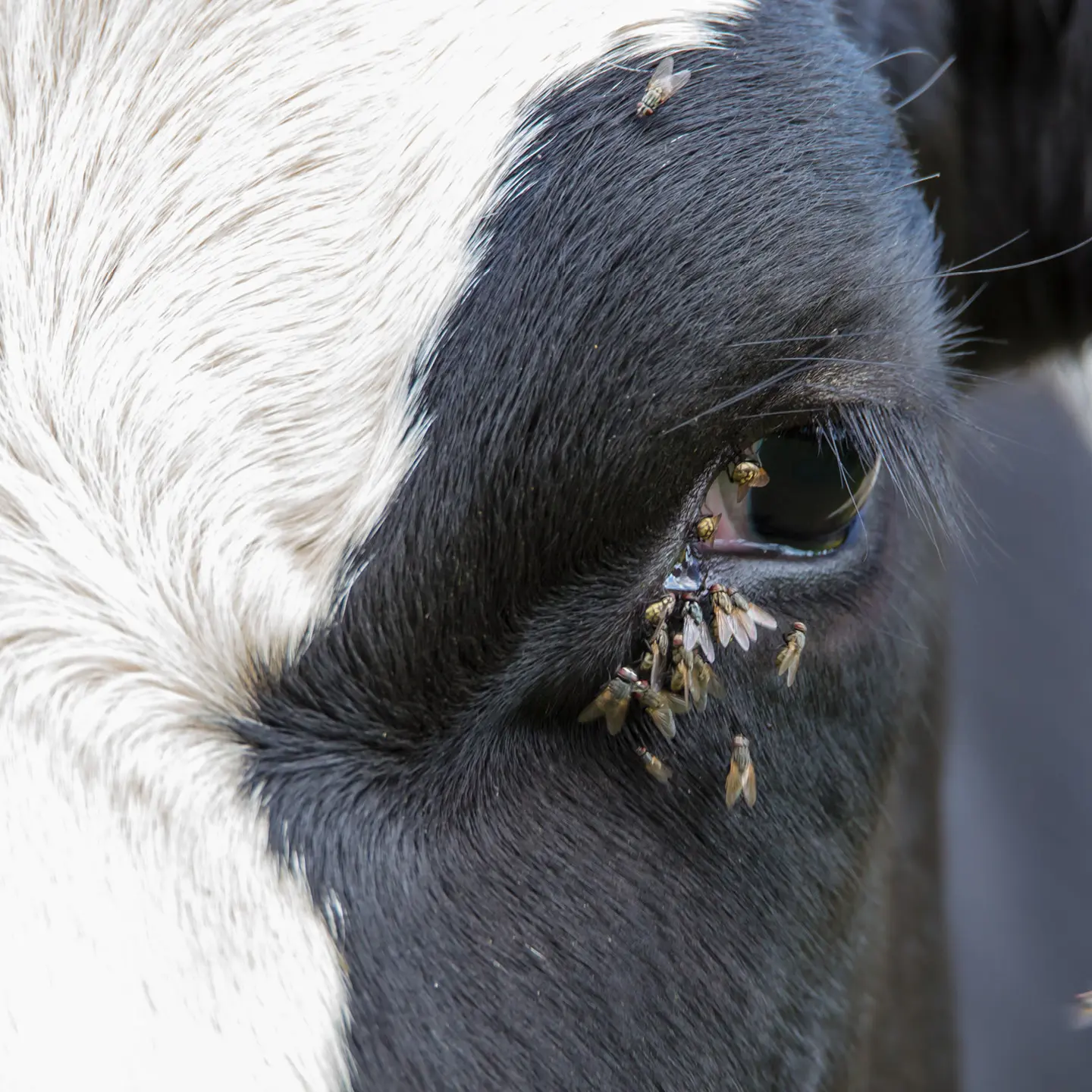
Face flies gather around the eyes, nose, and mouth. They do not bite, but they spread disease, and are an annoyance to dairy cattle. These flies are closely linked to pinkeye because they move bacteria from animal to animal. Face flies also stress cattle, you’ll see them throwing their head in the air, rubbing, and face flies will reduce grazing time.
Besides pinkeye, research indicates that flies can spread Highly Pathogenic Avian Influenza (HPAI).
Economic Losses
Flies cost dairy producers money in many ways. Some losses are easy to see. Others slowly chip away at profit. Milk loss is one of the biggest economic problems from flies.
Studies have shown that fly stress lowers milk production because cows spend less time eating and more time fighting flies.
Research shows flies cost the U.S. dairy industry hundreds of millions of dollars every year through lost milk production, reduced feed efficiency, stress, and disease spread. One of the most widely cited university-backed studies estimated that stable flies alone cause about $360 million annually in losses to U.S. dairy cattle producers. When beef sectors were included, total cattle industry losses reached roughly $2.2 billion per year (Taylor et al., 2012).
The study, conducted by researchers from the University of Minnesota and University of Nebraska–Lincoln, found that stable flies reduce milk production, increase stress, and hurt overall cow performance. Researchers estimated dairy cows lose an average of about 306 pounds of milk per cow annually under stable fly pressure.
More recent research from the University of Minnesota also showed that fly infestations increase defensive behaviors such as stomping, tail swishing, and head tossing, all of which reduce resting and feeding time for dairy cows. Even small drops in milk production become expensive across a whole herd over an entire summer.
Additionally, flies lower feed efficiency because stressed cows do not use nutrients as well. Cows may eat less or burn extra energy fighting flies. That means more feed is needed for the same level of production, which will hit your bottom line and keep feed bills high.
Flies spread disease and increase vet bills. Eye infections, mastitis risk, and skin irritation all raise treatment costs. Fly control products cost money, but poor fly control often costs even more. As with all diseases and pests, money spent on preventative measures will be less than the money the pests rob. Farms with severe fly problems usually spend more time spraying cattle, treating disease, and handling stressed animals.
Mastitis
House flies and stable flies can spread bacteria linked to mastitis. Dirty fly populations moving between cows can carry pathogens onto teat ends. Mastitis lowers milk quality and increases treatment costs. Severe mastitis can even force producers to cull cows.
Studies have found that stable flies can carry mastitis-causing bacteria such as Staphylococcus aureus, Klebsiella, and E. coli on their bodies and transfer them throughout dairy facilities. Horn flies may also increase mastitis risk by feeding on udders and irritating teat tissue, which can allow bacteria to enter. Recent university research suggests that controlling fly populations may play an important role in reducing mastitis pressure and improving udder health on dairy farms (Nayani et al., 2024; Sommer et al., 2025).
Biting flies create wounds and irritation. Open skin areas can become infected. Flies also spread bacteria that increase skin infections and inflammation. Heavy fly pressure creates long-term stress. Stressed cattle may have weaker immune systems, making them more vulnerable to sickness.
Cleanliness Matters
Sanitation is the backbone of fly control. Flies breed in wet, rotting organic matter. Removing breeding sites greatly reduces future populations. Old hay, spilled feed, wet bedding, and manure piles should be cleaned often. Experts note that stable flies especially thrive in wet feed and bedding waste. Keeping lots, feed alleys, and calf areas dry helps reduce fly breeding.
Also, manure removal is one of the best ways to control flies. Although it’s time consuming, in the summer, manure should not sit wet for long periods. Composting manure properly can also reduce breeding sites.
One simple thing dairies can do is to strategically place fans. Fans help reduce fly activity. Strong airflow makes it harder for flies to land on cattle. Fans also improve cow comfort during hot weather. Many dairies use large barn fans in holding pens and resting areas for both heat and fly control.
Additionally, pasture rotation can reduce manure buildup and lower fly breeding areas. Dragging pastures during hot, dry weather may help manure dry faster.
Fly Control Products
There are many products available for fly control. No single product works forever or in every setting. Good fly control programs rotate products and combine methods.
Pour-ons are common because they are simple to use. They can control horn flies and some biting flies for several weeks. However, overuse can lead to resistance. Some fly populations no longer respond well to certain insecticides.
Rotating active ingredients is important and creating an Integrated Pest Management program.
Fly tags release insecticide slowly from ear tags worn by cattle. These are popular in pasture systems and can work well against horn flies and face flies. Tags should be removed at the end of fly season. Leaving old tags in too long increases resistance problems.
Dust bags and oil rubbers are not new, but they’re reliable and easy to use. Back rubbers can provide steady control but require upkeep and fresh insecticide.
Sprays give quick knockdown of flies. Many producers use sprays in parlors, holding areas, or during cattle handling. They can provide almost immediate relief to cattle. The downside is short residual activity. Rain, sunlight, and sweat can reduce effectiveness quickly.
Next, we have feed-through insect growth regulators, often called IGRs, prevent fly larvae from developing in manure. These products do not kill adult flies directly. Instead, they break the fly life cycle. They work best when most manure on the farm comes from treated animals. Some producers report good results from mineral mixes and feed additives containing IGR products.
Lastly, fly traps can reduce adult fly populations. Research has looked at walk-through traps and vacuum systems for dairy cattle. Walk-through traps force flies off cattle as cows move through narrow lanes. Some dairy farms have seen strong reductions in horn fly numbers using these systems. Sticky traps, baited traps, and vacuum traps can also help inside barns and parlors.
Integrated Pest Management
Resistance is a growing problem in fly control. Using the same insecticide year after year allows resistant flies to survive and multiply. Rotating chemical classes slows resistance.
Integrated pest management, often called IPM, combines many control methods together.
An IPM plan may include: sanitation and cleaning protocols with feed-through products, sprays, fly tags, traps and tapes, barn fans, and close monitoring.
Farms using multiple methods often get better long-term control than farms depending on only one product. Resistance is a growing problem in fly control. Using the same insecticide year after year allows resistant flies to survive and multiply. Rotating chemical classes slows resistance. The best fly programs focus on prevention first and incorporate at least a couple different products and modes of action to control and prevent flies. This will help prevent resistance in flies. Waiting until fly numbers explode makes control harder. Early season treatment is usually more effective than trying to fix severe infestations later. Monitoring fly counts helps producers decide when treatment is needed.
The Future of Fly Control
Flies are a major problem in dairy cattle production. They reduce milk output, spread disease, stress cows, and hurt farm profits. Stable flies, horn flies, face flies, and house flies each create different challenges, but all can impact herd performance.
University studies clearly show that heavy fly pressure changes cow behavior and lowers production. Economic losses from flies reach into the hundreds of millions of dollars each year across the cattle industry.
Fly control will continue changing as resistance grows and new technology develops. Researchers are studying genetics, better traps, biological controls, and new insecticides. Some studies suggest cattle genetics may even influence fly resistance. New walk-through traps and vacuum systems also show promise for reducing chemical use. As dairy farms focus more on cow comfort and animal welfare, fly control will remain an important part of herd management.
Good fly control starts with sanitation and manure management. Clean facilities, dry bedding, strong airflow, and regular monitoring all reduce fly pressure. Products like pour-ons, sprays, fly tags, feed-through additives, and traps can help when used correctly.
The best fly programs use several tactics together. No single product will solve every problem. Dairy producers who stay ahead of flies instead of reacting late usually see healthier cows, better milk production, and lower long-term costs.
References:
Taylor, D. B., Moon, R. D., & Mark, D. R. (2012). Economic impact of stable flies (Diptera: Muscidae) on dairy and beef cattle production. Journal of Medical Entomology, 49(1), 198–209. https://doi.org/10.1603/ME10050
Nayani, S., Meraj, S., Renyard, A., et al. (2024). Blood-feeding stable flies, Stomoxys calcitrans (Diptera: Muscidae), are attracted to, and transmit Staphylococcus aureus, a causal agent of bovine mastitis: A laboratory pilot study. Journal of Medical Entomology, 61(6), 1470–1478. https://doi.org/10.1093/jme/tjae103
Follow us on Facebook! American Dairymen | Facebook