Finding Growth Within Your Herd
Is Your Next Growth Opportunity Already in Your Herd?
World Dairy Expo celebrates what’s next. But some of the industry’s most valuable opportunities come from taking a second look at what has already proven itself.
By Kelsey Hunt, Union Agener Dairy Accounts Representative
When you think about the next opportunity to grow your dairy, where do you look? More cows, additional capacity, new technology and capital improvements are all likely part of your answer. But growth can also come from looking inward at the productive potential of the cows and resources already in your herd.
Across the dairy industry, continued advances in facilities, automation, genetics, cow comfort, nutrition and data have given producers more ways than ever to improve performance. With so much attention focused on what is new, however, there is also value in taking a fresh look at proven technologies and the role they can play in today’s dairy.
For producers evaluating their next investment, increasing productivity per cow presents a compelling growth opportunity. Additional production from the existing herd can make better use of facilities and other resources already committed to the operation, without requiring a proportional increase in herd inventory or fixed costs.
Productivity Changes the Economics of Growth
The economic advantage of increasing production per cow begins with the dilution of maintenance and fixed costs. As milk production increases, a smaller proportion of the cow’s total energy requirement is devoted to maintenance, improving efficiency per pound of milk produced. In practical terms, greater productivity allows more of the resources invested in each cow to contribute to saleable production.
The same principle applies economically across the dairy. When additional production comes from an existing cow, the producer is not replicating the entire cost structure associated with adding another animal. Facilities, labor and other fixed resources are already committed to that cow and her production. The relevant calculation becomes the value of the additional milk relative to the incremental cost required to produce it.
This is where productivity technologies become especially valuable. The opportunity is not simply to produce more milk, but to generate more output from resources the dairy is already supporting.
For more than three decades, Posilac™ has been used to increase milk production in eligible lactating dairy cows, not by adding cows or facilities, but by increasing production from animals already in the herd.
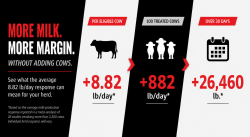
A meta-analysis of 26 studies involving more than 1,500 cows reported an average response of 8.82 additional pounds of milk per cow per day, with a 95% confidence interval of 7.08 to 10.56 pounds.
That response provides a more useful framework for evaluating Posilac economically: not simply by acquisition cost, but by the value of the incremental production it generates.
An Investment with an Immediate Response
Return matters, but so does the time required to begin generating it. One characteristic of Posilac that differentiates it from many productivity investments is the speed at which producers can begin observing a production response.
Increased milk production begins to appear the day following the first application, with response building progressively through approximately the first four to five doses before reaching a sustained level through the treatment period.
That short response interval has meaningful implications for both return on investment and cash flow. Improvements in facilities, equipment or herd size can create substantial productivity gains, but they generally require significant upfront capital and a considerably longer period over which the investment must be recovered. Posilac operates on a much shorter economic cycle: the investment is made at the cow level, additional production begins rapidly, and the resulting milk enters the farm’s normal revenue stream right away.
Under favorable economic conditions and an adequate production response, the additional revenue generated by an application can cover its cost while contributing cash flow toward subsequent applications and other farm investments. This self-financing potential has been an important part of the economics surrounding the technology throughout its commercial use.
The calculation, of course, remains farm-specific. Milk price, component value, feed cost, production response and product cost all influence the return. But those variables reinforce the importance of evaluating Posilac on the margin it creates rather than viewing it exclusively as another cost per cow.
Efficiency Extends Beyond Milk Yield
The same dilution of maintenance requirements that affects production economics also influences resource efficiency. As productivity per cow increases, less maintenance energy and protein are required per unit of milk produced. At the herd level, a given quantity of milk can therefore be produced with fewer total cows and, consequently, fewer replacement and dry animals supporting that production.
Research evaluating the environmental implications of Posilac demonstrated reductions in maintenance energy and protein requirements per unit of milk produced of 11.8% and 7.5%, respectively. Total feed required declined 8.1%, while manure production declined 6.8% and methane emissions 7.3%. Nitrogen and phosphorus excretion were also reduced by 9.1% and 11.8%, respectively.
Those numbers are significant because they frame sustainability in terms dairy producers have been managing for generations: production efficiency.
The distinction between environmental impact per cow and environmental impact per unit of milk is critical. A higher-producing cow may consume more feed and generate more total manure than a lower-producing cow, but comparing the animals individually ignores the additional cows required to produce an equivalent quantity of milk.
Greater productivity changes that denominator. Fewer, more productive cows can produce the same volume of milk while reducing the total maintenance requirements associated with the herd. Fewer productive animals also mean proportionally fewer replacements and dry cows, with corresponding reductions in feed, land use, waste production and greenhouse-gas emissions per unit of milk.
This is where productivity, profitability and sustainability are increasingly intersected. For the producer, feed efficiency and fixed-cost dilution affect margins; for the broader dairy supply chain, those same efficiencies reduce resource use per unit of food produced. Rather than competing objectives, economic and environmental efficiency can often be different measures of the same improvement.
Proven Technology in an Industry Focused on What’s Next
Few industries pursue incremental improvement as relentlessly as dairy. Decades of genetic progress, increasingly sophisticated nutrition and advances in cow comfort have continued to raise productive potential, while automation, precision monitoring and reproductive technologies have given producers new ways to capture it. Together, those advancements continue to redefine what is possible with the modern dairy cow.
World Dairy Expo brings many of those advancements together every year, making it one of the industry’s greatest showcases of the constant search for what comes next. Against that backdrop, a technology with more than 30 years of commercial history might not immediately fit the conventional definition of “innovation.”
Perhaps the definition deserves reconsideration.
Innovation has value because it solves a problem, not simply because it is new. More than three decades of Posilac use have created something an emerging technology cannot immediately replicate: an extensive body of research, commercial experience across different production systems and a well-characterized understanding of the production response. In an industry increasingly populated by sensors, robotics, advanced analytics and emerging technologies, maturity should not be mistaken for irrelevance. Decades of experience can provide the consistency, and predictability producers need when making management decisions.
Thirty years of history doesn’t make a technology less innovative when the problems it solves are still shaping the future of dairy.
Dairy producers still need to generate greater returns from feed, facilities, labor and capital. They are still evaluating how to increase production without increasing costs at the same rate, while being asked to improve environmental efficiency without compromising economic viability.
Your next opportunity for growth may not begin with another barn, another pen or another hundred cows. It may begin by asking more of the productive capacity already in your herd. As you consider what comes next for your diary, don’t overlook what has already been proven. Talk with your veterinarian, nutritionist or Posilac™ representative today about the role Posilac could play in your herd’s productivity strategy or visit UnionAgener.com to learn more.
Follow us on Facebook! American Dairymen | Facebook