Modern Dairy Facilities
Modern Dairy Facilities
Dairy cattle were once a fundamental staple on just about every farm. Today, that has changed, and we’re focused on specialization, maximum production, and marketing to make our dairies most profitable. Arguably, the dairy facility aids or detracts from your bottom line and your farm’s success. We have progressed far beyond simple shelters; contemporary barns are sophisticated, carefully engineered environments designed to promote comfort, streamline labor, and minimize biosecurity threats. A dairy facility is not merely a structure; it is a carefully planned and thriving system intended to promote maximum production. This can be a costly undertaking where modern producers, technology, and upgrades come into the picture.
When it comes to designing a dairy facility, you need to consider your local climate and prepare for adverse weather. Prime Buildings, officially Prime Building Components, LLC., is a full-service metal building and metal building component manufacturing company with a foundation in integrity and a commitment to producing high-quality pre-engineered metal structures. Ike Damstra, Metal Building & Dairy Sales for Prime Building Components, says, “We use advanced metal building design software to design structures that meet the exact needs of each dairy. Every project receives custom-engineering and takes into account snow loads, wind speeds, seismic requirements, cow flow, and future expansion plans. Using detailed CAD and 3D modeling tools, we are able to lay out every aspect of the building around current or planned equipment. This avoids potential structural conflicts.”
Little Improvements Make BIG Differences
The idea of modern dairy design is based on a singular principle that a healthy and comfortable cow yields higher production. Damstra says, “Cow comfort isn’t just a consideration in dairy facility designs; it’s one of the main drivers behind every design decision we make. From the structural layout to ventilation planning, every element is engineered to support healthier cows, better production, and long-term dairy success.”
The cow’s environment is critical. As we know, dairy cattle are susceptible to heat stress, making effective ventilation an absolute requirement. Farmers frequently reflect on this evolution in practice. “My grandfather thought the thick stone walls kept the cows warm in winter,” notes David King, a third-generation farmer in Wisconsin. “We now know they needed airflow in summer, not just shelter. The biggest difference in our new freestall barn is the fans and ventilation system. That’s where the investment went. We saw production jump the minute we focused on getting rid of heat and humidity, not just keeping out the rain.” This observation highlights the benefits of creating a more comfortable microclimate using ventilation systems and large circulation fans to maintain cooler temperatures in the heartland’s hot and humid summers.
Effective space management is equally vital. Inadequate space leads to social stress, competition, and increased incidents of injury or lameness. A study from the University of Kentucky College of Agriculture, Food and Environment Cooperative Extension Service, conducted by Lilly Robertson and Donna M. Amaral-Phillips, provides valuable insight into optimal stocking density. They had a control group of 100 square feet per cow, and found that generally cows performed best at 100% stocking, meaning having a stall or 100 square feet of area per cow of bedded pac. They found that this maximizes rest, reduces stress, and supports higher milk production.
However, when looking at your farm’s profits, the study showed that you would want to increase stocking density depending on milk price, feed costs, and stage of lactation. Overstocking above 100% can reduce milk yield, milkfat, and conception rates, increase somatic cell count, and raise culling risk. Importantly, fresh and close-up dry cows need more space, with ideal stocking densities at or below 80% to prevent transition diseases and avoid long-term production losses, especially in first-lactation cows that are more vulnerable to social pressure and overcrowding. So, by giving your cows adequate space in your facility, you could begin to see more profits on your farm.
Additionally, the resting surface must be consistently clean, dry, and soft—an essential factor for maintaining health. This dictates the selection of materials, which must be durable, resistant to the corrosive dairy environment, and straightforward to sanitize, minimizing pathogen presence. Reinforced concrete, treated lumber, and structural metals form the framework, with specific surface materials chosen for superior drainage and maintenance ease. The entire facility must incorporate robust safety features for both livestock and personnel, including slip-resistant flooring, appropriate lighting, and compliant electrical infrastructure. Finally, the design must prioritize efficiency, often favoring wide-span, clear-span designs (without supporting posts) to maximize usable space and facilitate the movement of machinery, particularly automated feeding systems.
Metal Buildings
Metal buildings and sheds have become the modern standard for modern dairy cattle operations, offering numerous advantages over traditional wooden structures. Ike Damstra, Metal Building & Dairy Sales for Prime Building Components, states, “Prime’s structures are engineered to accommodate two types of power-ventilated barn designs: cross-ventilated barns and tunnel-ventilated barns. In cross-ventilated barns, fresh air enters through a full-length curtain opening along one sidewall. A fan wall on the opposite side runs the full length of the building, pulling air across the width of the barn.
To maximize airflow effectiveness, designers incorporate baffles at strategic points. These baffles redirect air down on the cow, preventing hot, stale, or “dirty” air from staying in the barn and circling just below the roofline and ensuring consistent air movement where cows need it most. Tunnel-ventilated barns have a full-width curtain on one gable end that serves as the primary air intake. The opposite gable ends design is to house the fan wall, pulling air through the length of the building. Instead of baffles, tunnel-ventilated barns typically employ additional interior fans to maintain uniform airflow and pull air down the length of the barn and out the end opposite the curtain opening.”
Damstra goes on to explain, “Prime’s role is to ensure the structure fully supports the ventilation plan by providing curtain openings sized appropriately for maximum required air intake, fan walls either on the endwall for tunnel-ventilated barns or on the sidewall for cross-ventilated barns, and structural accommodation for baffles and interior fans. We work hand-in-hand with the dairy’s ventilation supplier to ensure fresh air is constantly moving. “Dirty” air is removed, and cows benefit from a clean, comfortable environment year-round.”
Damstra goes on to emphasize the importance of growth and change potential on your dairy farm. “One of the biggest advantages of metal buildings over traditional construction in the dairy industry is their unmatched adaptability. Metal structures can be designed and modified to meet a wide range of operational needs, from ventilation and cow comfort to robotics, milking parlors, and future expansions. Unlike traditional buildings, which often require costly renovations to accommodate new equipment or workflows, metal buildings can evolve with the dairy, saving time, money, and disruption while supporting long-term productivity.”
He elaborates, “For example, if we are designing a building that is going to function as a traditional barn first, but will eventually have robotic milking equipment inside, we can lay out the building to ensure that we don’t have any structural members in the way of the future robots and milk rooms. For a more traditional parlor or rotary, we can pull in a model of the rotary, which helps us ensure that we have enough clearance and room in the building for the rotary as well as other rooms and offices. By incorporating equipment models into our design software, we can identify layout issues early, improve workflow, reduce construction challenges, and make future renovations significantly easier.”
Freestall Barns
The freestall barn has become the industry standard for most mid-to-large commercial dairy operations. In this configuration, cows house collectively in a large, communal area but utilize individual stalls or beds for resting, which promotes hygiene and protection. The typical arrangement features four or six rows of stalls separated by spacious walking alleys, often with a central feed bunk. This layout allows for constant cow traffic between feed, water, and resting areas. The primary benefit of the freestall design lies in its ability to support individual cow comfort and sanitation. By minimizing physical contact during rest and isolating the resting space from high-traffic, soiled paths, the incidence of udder infections (mastitis) and lameness is significantly reduced.
However, the efficacy of a freestall barn relies heavily on the precise design and ongoing upkeep of the stalls themselves. “I learned the hard way that a poorly designed freestall is worse than no stall at all,” shares David King. “Our old stalls were too short; the cows were half in and half out, and we were struggling with dirty udders and sore knees. We invested in deep-bedded sand stalls and adjusted the neck rail to give them lunge space. That single change cut our daily bedding time and dropped our somatic cell count dramatically. It’s not about how many stalls you have, it’s about making sure every stall is an inviting place to lie down.” This requirement for cow-specific ergonomics makes stall configuration one of the most intensively studied parts of dairy buildings.
Stanchion Barns
When we look at traditional stanchion barns, we see a benefit in the simplicity of the design. Although largely superseded by more flexible systems, stanchion barns remain in use in smaller, family-operated dairies or those managing specialized, high-value genetics where close, individual observation is paramount. The primary advantage is the ease of close monitoring; producers can easily assess individual feed intake, administer treatments, or collect specific milk samples. The stanchion barn is high-touch, low-tech, and the tradeoff is labor. Moving feed and manure requires far more manual effort, and the milking process is slower. It’s a system suitable for a producer who wants hands-on care. However, the labor requirements can limit you.
Hoop Barns
A fast-growing choice, particularly for deep bedding-pack management, is modern hoop barns. These buildings employ galvanized steel arches covered by durable, translucent polyethylene fabric. The benefits are substantial: they offer high cost-effectiveness compared to conventional steel or timber structures; they admit excellent natural light, which benefits animal health and observation; and their characteristic arch shape facilitates superior natural ventilation. The air movement is superior to any low-ceiling structure we used before.
Milking Parlors
When setting up a building, it’s important to consider future growth. When talking about Prime’s designs, Damstra says, “Our goal is to always take a proactive, not reactive, approach to incorporating innovative technology into our dairy facility designs. By anticipating future equipment needs, automation trends, and operational upgrades, we ensure our structures are ready for today’s tools as well as tomorrow’s advancements, keeping dairies efficient, adaptable, and ahead of industry change. Our buildings are intentionally engineered to accommodate the technologies dairies rely on today and the upgrades they plan for tomorrow.”
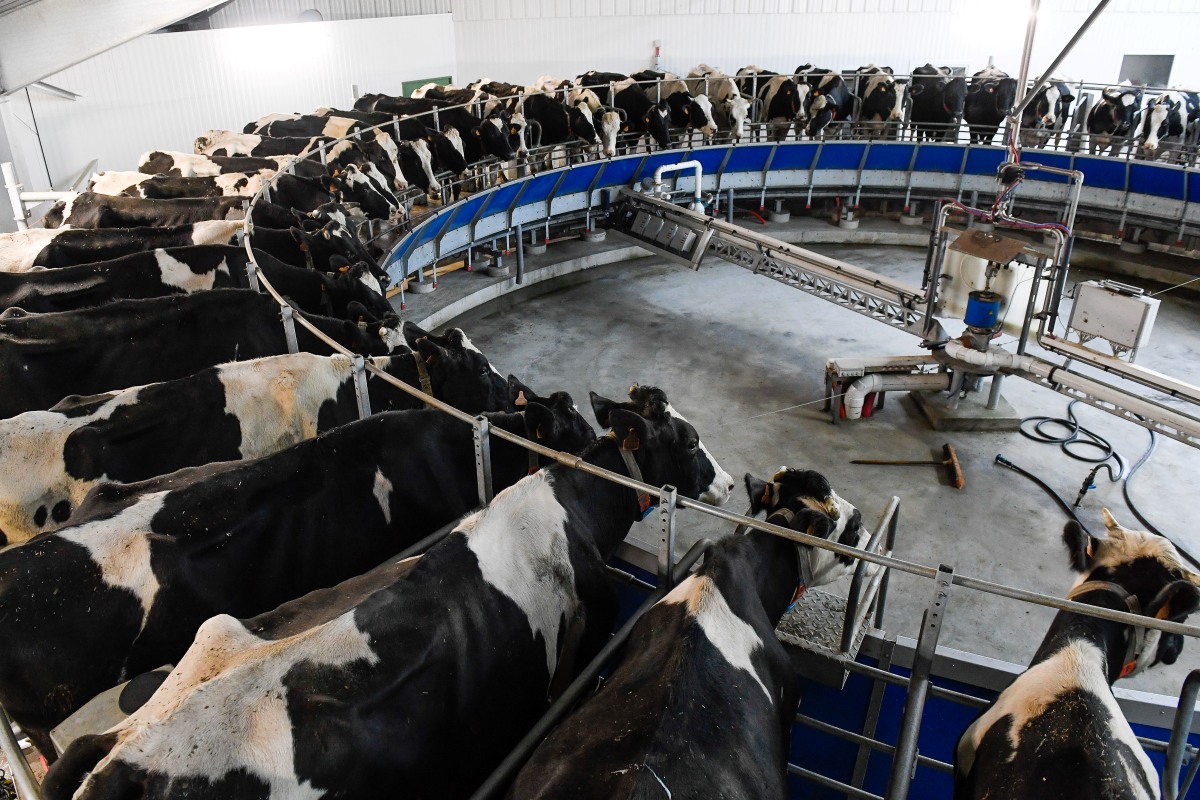
Milking parlors aren’t a fit for every farm, but they are an investment that can pay off through reduced labor and being able to support more cattle. Parlor design is specifically for operational speed and efficiency. The objective is simply to process the maximum number of cows in the minimum amount of time, thereby minimizing stress. Common layouts include the herringbone design. This is where cows position at an angle, parallel in design, where cows are standing perpendicular to the operating pit, and tandem designs where cows standing single-file lines.
The transition to a parlor system is often the single most significant labor-saving investment on a dairy farm. “When we switched from carrying buckets in the stanchion barn to a Parallel parlor, our milking time for the herd was cut in half,” recalls David King. “That’s three hours of my life I got back every day. The initial cost was terrifying, but the return on investment in terms of time and more gentle cow handling was realized within two years.” The most advanced solution incorporates fully automated systems. Robotic milking units allow cows to be milking voluntarily, 24 hours a day, at their individual pace. This fundamentally reduces the demand for manual labor but requires adaptation to monitoring data and robotic maintenance.
A well-designed modern dairy facility will help your cows stay comfortable and your dairy maximize profit.
By Jessica Graham
For Leading Cattle Industry News: