Summer Heat Strategies that Work
Summer Heat Abatement Strategies that Work
Sponsored by Bio-Vet
Seasonal heat abatement is one of the most important focuses for a productive dairy herd. Even if you aren’t in an exceptionally warm region, the research is very clear that heat stress impacts lactating cows and it happens sooner than you think. Beyond the obvious drop in production, heat has been proven to affect reproduction and overall health as well.
According to the University of Wisconsin Extension, cost versus return on investment is often favorable, as even modest declines in milk production or reproductive performance can quickly outweigh the cost of cooling systems.
Economics aside, welfare is always a concern, especially when animals rely on temperature controlled barns and spend part of their day waiting in holding pens. Heat stress can even be deadly if improper heat abatement measures are not in place.
What Makes Heat Stressful?
Heat stress is defined as the point at which a cow’s heat load exceeds her ability to dissipate heat. A large part of it is the temperature–humidity index (THI), which combines ambient temperature and relative humidity into a single value to estimate environmental heat load on cattle. This is outlined in the University of Nebraska–Lincoln Extension’s bulletin Heat Stress in Beef Cattle, by G. Erickson and T. Klopfenstein..
There are notable thresholds where dairy cows begin to experience stress, as outlined in University of Florida IFAS Extension’s bulletin Heat Stress in Dairy Cattle by Geoffrey Dahl. This threshold begins at a THI of 68. Mild, moderate and severe stress can occur at higher levels. Of course, this will vary somewhat according to breed, individual genetics and the animal’s own tolerance due to external factors.
Outside of the textbook definition, it’s more practical to rely on the tangible signs of heat stress so that managers and employees can respond as needed.
Heat stress can be grouped into six stages noted in Michigan State University’s bulletin Heat stress in cattle: Recognizing the signs and tips to keep your cattle cool, by Kable Thurlow and Kevin Gould.
Stage 1 is simply an elevated breathing rate (above 60 breaths per minute in mature cows), while stage 6 is full open mouth breathing with a protruding tongue, extremely labored breathing and decreased respirations with strained breathing. An animal’s head may be down, with or without drooling.
Other symptoms of wider subclinical heat stress include reduced dry matter intake and increased standing time. Animals that are most vulnerable to heat are fresh cows, high producers and heifers because of higher metabolic heat production and lower social dominance limiting access to cooling resources.
Physical Strategies
Producers can implement several different strategies to abate heat.. While they may not all be reasonable, heat abatement works best when it is addressed on multiple fronts.
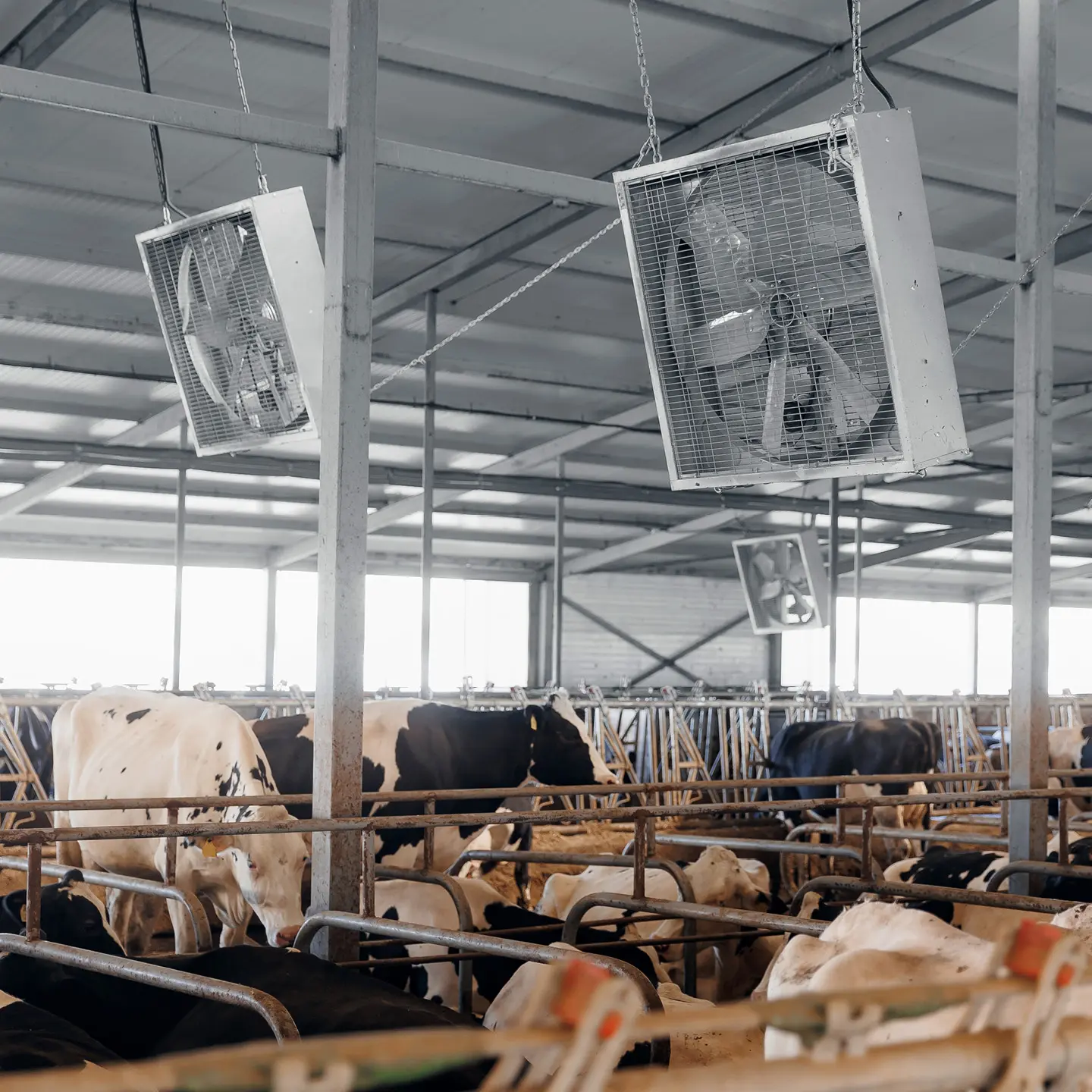
In typical freestall barn facilities,design should support airflow. Some operations fail in this regard because fans are improperly spaced and angled. Industry guidelines suggest that fans be spaced 20–30 feet apart and angled downward at approximately 15–20 degrees. According to a bulletin published by Pennsylvania State University Extension, Designing Dairy Freestall Barns for Cow Comfort.
For pasture or dry lot systems, shade, water access and sprinkler systems are the primary measures. According to a bulletin by the University of California Davis Extension, Cooling Dairy Cows in Dry Lots, 40–60 square feet of shade per animal is recommended. Additionally, they should be provided with at least 2–3 inches of linear water space per cow.
All dairies should pay attention to their holding pens and parlors. Fans should follow the same spacing guidelines as freestalls with higher airflow capacity, and sprinklers should be high flow, low pressure soakers delivering large droplets intermittently.
Simple as it may be, shade isn’t just shade. Natural and artificial sources are different by their ability to block solar radiation and maintain consistent cooling throughout the day. Per the University of Arizona Cooperative Extension’s bulletin Heat Stress Management in Dairy Cattle by Robert Collier and colleagues, artificial structures typically provide more uniform protection.
Layout Matters
Space requirements for cows are generally recommended at 40-60 square feet per animal in dry lot systems.
Consider north to south orientation to allow ground drying and reduce mud accumulation and use of reflective materials. Materials such as galvanized steel or shade cloth to reduce radiant heat load, according to the University of Nebraska–Lincoln Extension’s Shade Options for Beef Cattle.
Besides barn design, ventilation can be influenced by airspeed at the cow level and total air exchanges per hour. Also consider the strategic use of mechanical systems such as fans, tunnel ventilation and cross-ventilation to maintain consistent airflow.
Finally, water cooling systems that use sprinklers and misters may also help. Many of these work in tandem with fans. The key difference between the two is that sprinklers (or soakers) deliver large water droplets that penetrate the hair coat and cool the cow. They cool directly through evaporation, whereas misters primarily cool the surrounding air. Misters are less effective in humid climates.
Intermittent cycling (for example, 1-3 minutes on followed by 5-15 minutes off) is recommended to maximize evaporative cooling while minimizing waste according to the University of Florida IFAS Extension.
Soaker systems paired with fans are widely regarded as the most effective combination because fans accelerate evaporation from the cow’s skin, significantly improving heat loss compared to either system alone. Placement matters as well. Generally, feed bunks and holding pens are the highest priority for heat abatement measures due to crowding and reduced airflow. Freestalls can benefit from supplemental cooling, depending on barn design.
Water and Nutrition Management
Water and nutrition strategies become increasingly important as heat stress intensifies. Both should be adjusted proactively rather than reactively.
>Clean, cool, accessible water is essential, as water intake is the primary means by which cows regulate body temperature through evaporative cooling and physiological processes. In Penn State Extension’s Waterers and Water Systems for Dairy Cattle, linear water space per cow is generally recommended at 2-4 inches per animal.
Remember that water intake increases significantly during heat stress, often rising by 20-50% depending on severity, which makes both flow rate and refill capacity critical considerations.
Adjusting Rations
Finally, nutritional adjustments during heat stress are focused on maintaining intake while reducing metabolic heat production.
>Increasing energy density is a common strategy, as adding fat to the diet provides energy with a lower heat increment compared to fiber digestion, according to Penn State Extension.
The use of highly digestible forages helps maintain rumen function and intake, as poor quality forages increase fermentation heat and reduce feed efficiency under heat stress conditions.
Florida State’s bulletin notes that reducing the heat increment of feeding involves careful balancing of fiber and concentrates to support rumen health without excessive fermentation heat production.
Electrolytes such as sodium, potassium and magnesium are often supplemented because heat stressed cows lose these minerals through increased respiration and sweating-like processes.
Buffers, including sodium bicarbonate, help maintain rumen pH when reduced intake and altered feeding patterns increase the risk of acidosis. Yeast cultures and rumen stabilizers may support digestion and intake consistency, particularly during periods of fluctuating feeding behavior.
Heat stress is not a single factor challenge but a multifaceted one, where environment, nutrition and management all intersect. The most successful heat abatement strategies are those that layer multiple approaches together—ventilation, shade, water cooling, nutrition and cow handling—rather than relying on any single solution.
Producers who take a proactive approach, especially ahead of peak summer conditions, are better positioned to maintain production, protect reproduction and ensure animal welfare throughout the season.
This edit is sponsored by Bio-Vet. Visit them at: https://www.bio-vet.com/

Follow us on Facebook! American Dairymen | Facebook