Quality Silage and Haylage Tips
Tips for Putting up Good Quality Silage and Haylage
Many dairies depend on silage and/or haylage for part of the ration for lactating cows and young stock. Stored forage like silage can rarely match the nutritive value of fresh forage because some loss of highly digestible nutrients (sugar, protein, and fat) is unavoidable during conservation and storage, but high-quality silage or haylage can supply most of the nutrients needed. Quality depends on many things, however, including the quality of the crop itself, stage of maturity, harvesting methods and proper storage. Producing high-quality silage requires rapid, airtight fermentation to preserve the nutrients and minimize waste. The goal in forage conservation is to minimize losses, which start immediately after cutting.
What Determines Silage and Haylage Quality
Key steps include harvesting at optimal maturity and moisture/dry matter, with a fine, uniform chop length, maximizing compaction, and immediately sealing with high-quality plastic and weights if it is put into a silage pit rather than a silo. A properly sealed, dense, and well-fermented bunker should be left to cure for at least three to four weeks before feeding the silage.
Crop Planning and Preparation for Silage Production
It always pays to plan ahead for the next crop season. Steven Hines, Extension Educator (University of Idaho) says things to think about include maintaining machinery, such as the corn planter. “It helps to make sure all parts are in good working order and properly adjusted. A good corn crop starts with good soil, but also depends on the planter. The seed has to all be placed at the same depth, with even spacing between seeds, to maximize yield. It is imperative that all the plants emerge at the same time, to get the necessary uniformity,” he says.
Equipment Preparation for a Successful Silage Crop
“If you own your own forage harvester, you also need to check for worn parts, to see if there is anything you need to order, rather than waiting until it’s time to roll it out to the field. If all maintenance work is done during winter this can save time during planting and harvest,” he explains.
Choosing the Right Corn Variety for Silage
It’s also wise to work with your seed supplier and select a variety based on your particular needs. “If you are at higher elevation you’ll need a shorter season, shorter-daylight variety of corn. If your corn doesn’t fully ripen before frost, you are harvesting a crop with less quality,” says Hines.
“Seed companies now have varieties geared not only to a certain temperature environment but also to different types of soil and moisture conditions—whether full irrigation or water-limited.” You can customize the corn to your conditions and decide which variety will work best, and order that one early because sometimes the company will sell out of a particular variety early.
Why Early Seed Ordering Matters
“If you wait until the week before planting you may be stuck with the variety that is still in stock. There’s also possibility for price breaks if you order earlier in the season instead of during the heat of planting,” he says.
Take soil samples. Make sure you know the proper fertility for corn. “It’s also important to plan for the pop-up fertilizer that goes in with the seed, and any pre-planting-incorporated fertilizer and any in-season fertilizers you might want to put directly onto the leaves or through the sprinkler or irrigation systems,” he says.
If you are relying on a custom harvester it also pays to visit with them ahead of time, to know who you will hire, and to give them an idea about when the corn will be ready. “The readiness will be weather dependent, however. A cold spring might set it back two weeks. And you don’t want to be scrambling at the last minute to find someone to cut your corn. If it is ready to go and continues to sit in the field you are losing quality, and there’s also a chance it will get frozen, losing more tonnage. It helps to have all these plans in place ahead of time,” he says.
It’s never too early to start thinking about next year’s crop. “Most folks who do a lot of farming already have next year and the year after already planned. Those plans always need some flexibility, however,” he explains.
Haylage and Baleage: Modern Forage Storage Methods
Silage in piles, pits or silos has been the traditional way to store forage harvested wet–compacted and stored in airtight conditions, fermenting. In recent years, methods have been developed to wrap silage/haylage in airtight bags of plastic film. Harvesting and storing it this way can capture nutrient quality of forages without the losses often associated with trying to get it dry enough to bale and store without mold.
Animals with high nutritional requirements (lactating dairy cows, young animals) often perform better on baleage, and this can be a way to harvest and store good feed without trying to dry it during wet weather. Baleage technology has advanced dramatically in the past 15 years. Some dairies utilize crops other than corn and now prefer to harvest it as baleage. If it’s grass, it needs to be a nutrient-dense variety like ryegrass, leafy and digestible.
Ideal Moisture Levels for Baleage and Silage
John Hall, PhD (Extension Beef Specialist, University of Idaho, Nancy M. Cummings Research, Extension and Education Center) says there is a growing interest in baleage, due to weather challenges when harvesting forage. “The forage needs to be between 45 and 60% moisture, and usually toward the higher end is better. One of the challenges, with all that moisture, is that the bales are very heavy and weigh about twice as much as a dry bale.” This puts more stress on the baler.
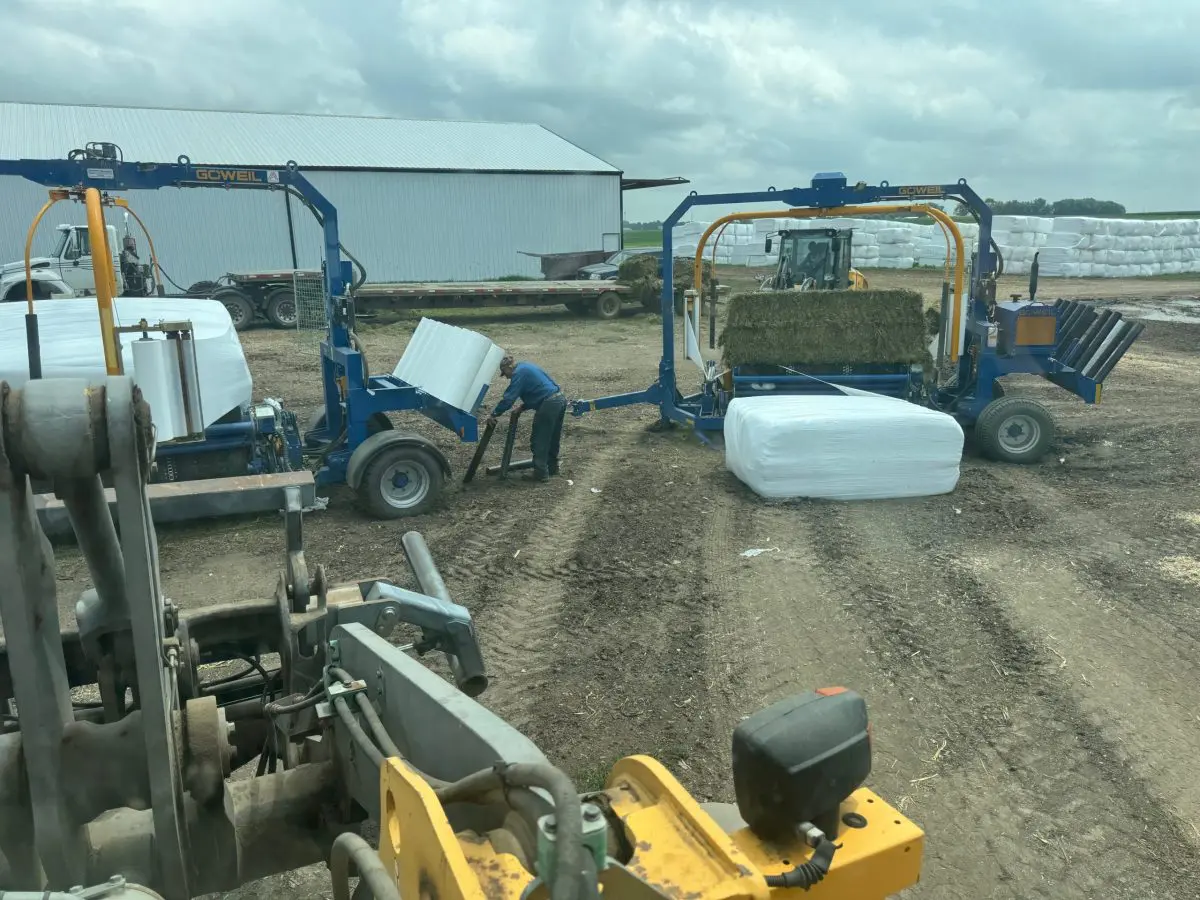
“Many of the newer balers are set up to do both dry and wet bales. We can do round bales or big square bales, with the new equipment available to wrap them. There’s also a variety of different wrappers,” says Hall. Some wrappers encase each bale individually and some wrap multiple bales in a long tube.
Bale Wrapping Methods: Individual vs Inline Systems
“The advantage of individual bale wrappers is that they are a lower-cost machine up front, though it will cost a little more in terms of plastic per bale—because you are wrapping all sides of each bale. There are some handling issues because you need to handle them with a different piece of equipment or patch every bale after you put a spear in it, and seal up that plastic again,” he explains. There are some special bale-handling grabbers that don’t tear the plastic.
“The advantage of the inline method is that it is much faster and takes less plastic–only wrapping the sides of the bales,” says Hall.
“For producers who are doing a lot of baleage, use of inoculants might be worthwhile. In order to use those, however, you need a piece of equipment to add to the baler, to spray the inoculant onto the forage as it goes into the baler. There seems to be some improvement in protein quality and stability, as well as increase in digestibility when inoculants are in use. They help the fermentation process go more rapidly. There are a variety of inoculants so a person needs to do some research to see which one might be best for their situation. In general these are either lactobacillus or propionic acid. These are very helpful when the forage is at the right moisture for putting up baleage, but I don’t know if they help if it’s a little on the dry side,” he says.
Pros and Cons of Baleage Systems
The disadvantage of baleage is the challenge of transport if you have to take these bales very far to feed them. They are very heavy because of all the moisture. “Whether or not they are feasible depends on how far you have to take them and how you are using them,” he says.
“One of the issues with wrapped bales is wildlife. Mice can get into them and then the coyotes go after the mice and you have holes in the wrap,” he says.
One disadvantages of the inline system is that you can’t stack the bales, so it takes more space to store them. Every situation is different and will determine which method you ultimately choose. “A lot of the people who are using baleage prefer the inline wrappers. The bales can be transported wet to the location where they will be wrapped,” says Hall.
Testing for Moisture in Baleage Systems
“If producers want to use this haying method they need to understand things like wilting times and how much moisture to end up with. Most of our moisture testers for hay don’t go up as high as round bale silages need to be. You need to have the right tester. Learning how long you need to dry it on a certain day, to get down to 50% moisture, is crucial. It might be just a few hours in the heat of summer or it might be overnight in a cooler time of year,” says Hall.
Moisture level is crucial because if it’s too dry it won’t ensile and will mold. If it is too wet you lose a lot of yield; the material becomes runny and slimy with too much liquid. “A lot of the soluble carbohydrates end up in the fluid and can be lost,” he says. It takes a while to learn how to do it properly.
Wrapping Bales
The wrap (plastic film) comes in two versions: individual bales, and in a long tube, but there are many different types of wrappers. The tubes may not have advantages over bagged or bunker silage, depending on your situation, and bagged silage has some advantages over poorly bunkered silage.
Baleage may be feasible in many situations as a supplemental high-protein forage like alfalfa and may also be the best way to capture some supplement-quality hay like wheat or oat hay in wetter climates. Traditional silage can be put up cheaply but spoilage losses are often high, adding to the final cost. Silage also requires different equipment to feed than what is required of baleage for a person who already uses bales.
Bill Godfrey (in Oklahoma) grows a lot of forage and uses baleage. “I’m mainly concerned about quality rather than volume. Putting up good-quality forage as baleage gives a two-fold advantage. It provides a quality product and harvesting is not weather-dependent. This is a big concern if you are putting up a large quantity/tonnage product. When you look at all the harvesting equipment today, there has been a big change; all the machinery manufacturers have multiple products for making baleage,” he says.
Controlling Moisture in Bales
One concern people have regarding harvesting the wet forage is that you are storing and hauling something that is 50% water. “If you take a 5-by-5 or 4-by-6 bale of baleage it will weigh about a ton, using the new equipment. Even if it is 50% moisture (or less, if the farmer uses a preservative and gets it down to 45% moisture) and there’s only 1000 pounds of dry matter, the quality is so much better that you don’t need any supplement,” he says.
Baleage Moisture Levels and Weight Considerations
“You have a high-quality product that costs more to put up and store but requires no supplementation, and in the end may actually be cheaper. When you feed it and open up the tube, however, the exposed hay starts to spoil, especially in summer when weather is warm. In winter you can get by for a couple days without much spoilage loss. Some people push a dry bale onto the exposed end, but there will still be some spoilage. It’s still less spoilage than you’d have on a silage pit. If you are going to do in-line baleage you should do long rows, to reduce waste,” he says.
Spoilage Risks and Feedout Management
“In my operation I could probably get away with doing tube-line but I do some baleage of winter annuals crops, baling and wrapping in May-June. Then we’ll have a summer forage that we’ll bale and wrap later, and possibly a late summer crop that we don’t actually bale until fall. I am not doing all of mine at one time. The argument for tubes is that they are the most cost-effective if you are doing 500 or more bales per year, and for my operation this would probably work and be cheaper, but I’d either have to buy or rent a tube-line wrapper or hire someone with a tube-line wrapper to come wrap bales on my schedule for harvesting.
Perhaps on the harvesting side the tube-line makes the most sense, but on feeding it out I am not sure it does. I like the individually wrapped bales and the fact that you can stack them, and if you are ever going to sell some, they are easier to transport—versus cutting them out of a tube or row. In the winter you might get by without feeding it up immediately but in the summer you can’t,” says Godfrey.
Silage vs Baleage: Which Is Better?
Traditionally silage is an energy crop like corn or sorghum, whereas baleage is putting up a hay-type forage. “Some people have tried doing corn silage as baleage but you have to use more plastic wraps because the stalks poke holes in it otherwise. From a cost standpoint, if you’ve always had a silage operation and have the equipment it makes sense to keep doing it. With some of the grasses and forage sorghums or even triticale or rye, or winter annual cereal grains for stored forage it may make sense to chop and bag them,” says Godfrey.
Final Tips for Producing High-Quality Forage
“It all depends on your own situation and operation. If you already own the haying equipment, when you upgrade hay balers you might buy one that has cutter knives and is for baling. You can simply lift the knives and do dry hay also, and then you have an option. Then you need to buy or rent a wrapper,” he says.
June 2026
By Heather Smith Thomas
Follow us on Facebook! American Dairymen | Facebook