Turn Herd Data into Action with Connected Systems
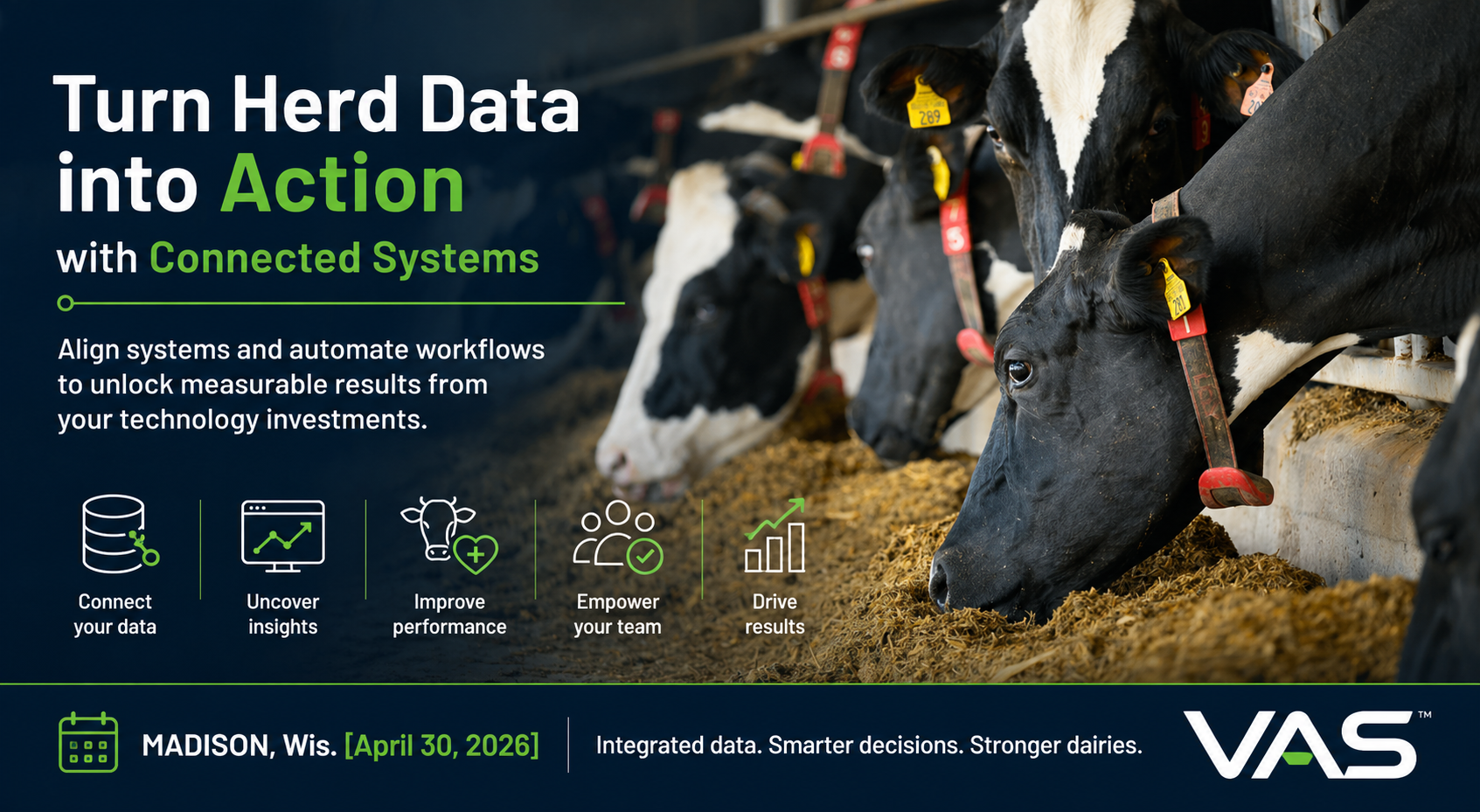
Turn Herd Data into Action with Connected Systems
Align systems and automate workflows to unlock measurable results from your technology investments.
MADISON, Wis. [April 30, 2026] – Today’s dairies generate more data than ever — from herd management software to monitoring systems, parlors and sort gates. Despite these advances, information often remains siloed, making it difficult to turn insights into action across the farm.
“Some farmers are still pulling information from multiple places and piecing it together,” says Melissa Freitas, farm performance consultant at VAS. “For example, feed and herd data are often analyzed separately. That makes it harder to see how nutrition, health and production are truly connected, limiting the ability to fully understand performance and profitability across the entire dairy.”
When data streams are integrated, you can see how changes in one area — such as ration consistency or dry matter intake — influence milk production, reproduction and health events.
Emerging data integration platforms help bring these pieces together, making it easier to layer data, identify trends and act on insights across the business.
Make more informed decisions, faster
Collecting data is only the first step. The real challenge is knowing how to use it. Instead of focusing on pulling reports, Freitas encourages farmers to start by identifying the question they’re trying to answer.
“Ask yourself what you’re trying to solve, not just what report you want,” she says. “That’s how you turn information into something actionable.”
This becomes especially important in complex areas like the maternity pen, where multiple factors — such as colostrum timing, nutrition and time in the close-up pen — influence outcomes.
“Farms often try to track one moment, like when a calf was fed colostrum,” says Freitas. “But that moment might not be the single driver of a negative outcome. It could be how many feedings the calf received, what her dam was eating before calving or how long she was in the close-up pen. When you layer that information together, that’s when you find the real issue.
Herd management platforms like DairyComp bring together data to help uncover the root issue and determine the right course of action.
Improve labor efficiency
Connected data can fundamentally change how work gets done on the farm. Instead of spending time searching pens or tracking down animals, employees can focus on care and timely interventions.
“You’re bringing the cows to you instead of searching for them — that alone is a huge efficiency gain,” says Freitas.
By connecting systems like parlor data, sort gates and monitoring tools, farms can automatically identify and sort animals that need attention. Cows are sorted and waiting in a designated pen for breeding, treatment or hoof care, reducing time spent walking pens and allowing teams to work more efficiently.
Dairy data systems automation also improves consistency. Daily task lists and mobile tools like Pocket CowCard ensure employees know what needs to be done each day, regardless of who is on shift.
“It creates consistency for both the cows and the team,” Freitas says.
The result is less time spent searching, faster interventions, better animal care and more efficient use of labor.
Focus on key metrics
Focus on a core set of metrics directly tied to herd health, reproduction and production. Then see how those metrics connect across the farm.
“No single number tells the whole story,” Freitas explains. “It’s how those metrics work together that helps you understand what’s really happening on your farm.”
Start with disease incidence rates in calves and fresh cows, which often signal where protocols may be breaking down. Then look at reproduction metrics like heat detection and pregnancy rate to evaluate how well cows are transitioning, cycling and getting bred back on time.
Production metrics — including milk yield, components and somatic cell count — show how those upstream decisions are impacting performance.
Feed intake and efficiency add another critical layer. As the largest expense on most dairies, even small shifts in dry matter intake or ration consistency can quickly show up in milk production and reproduction.
“When you connect these data points, via integrations and your herd management platform, you can move beyond reacting to individual issues and start identifying patterns to pinpoint where adjustments in nutrition, protocols or labor can have the greatest impact,” says Freitas.
Achieve measurable ROI
When data systems are aligned and used effectively, the impact is measurable. Metrics like pregnancy rate and milk production per cow often improve first as teams can identify and act on issues sooner. Better compliance, earlier disease detection and more timely interventions all contribute to these gains.
“The first thing most farms notice when data sources are connected is they’re getting to every cow that needs attention,” says Freitas. “From there, you start to see improvements in pregnancy rate and milk production because you’re not missing those opportunities anymore.”
Farms also often see improvements in employee morale, as workflows become more streamlined and less physically demanding.
“Start with one area that’s costing you time or performance and dig into the data behind it,” says Freitas. “When you connect the right metrics and review them with your team, that’s when you start to see real change.”
You can begin breaking down data silos by focusing on a few practical steps:
- Identify one priority area where delays or inefficiencies can be costly — reproduction, health or milk production
- Evaluate your current data sources to understand what systems are collecting information and where gaps exist
- Work with your technology partners to connect systems where possible, allowing data to flow between tools instead of living in separate platforms
- Establish key metrics and review them consistently with your team to guide management decisions and track progress
- Start small and build — even incremental connections, like syncing activity levels from activity monitoring systems, can lead to more efficiencies and measurable improvements over time
More about VAS
Learn how VAS helps dairies integrate data, streamline workflows and manage with confidence at VAS.com.
VAS is the global market leader in connected farm management systems. For over 40 years, VAS has been the operating system of choice for the most innovative dairies. VAS’ software and information solutions help collect and connect a farm’s data – from herd management to feed performance, tracking and more. These insights are a source of truth, empowering producers and their trusted advisors to make profit-driven and sustainable management decisions. At the forefront of thought leadership within the dairy industry, VAS is trusted by the producers we serve and the greater dairy community.
Follow us on Facebook! American Dairymen | Facebook